

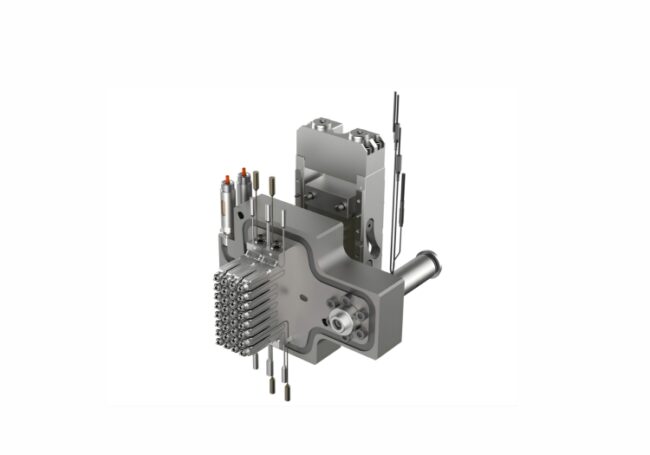
GÜNTHER has introduced a new valve gate system, marking a significant advancement in hot runner technology. The development sets new benchmarks in compact design and precision, enabling high-density injection configurations.
The system features extremely narrow gating dimensions, accommodating 32 injection points within a compact area of just 70 mm x 35 mm. This achievement has been realised through close interdisciplinary collaboration between the mould maker and the hot runner supplier.
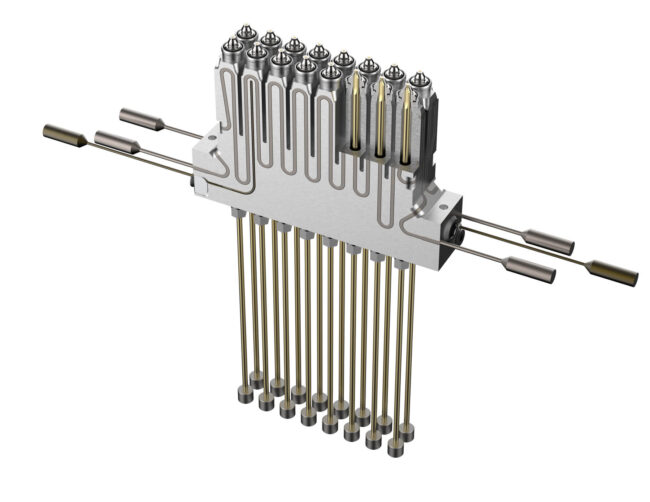
At the core of the system is a high-precision electric valve gate, designed to allow easy and accurate adjustment of the needle position. This is complemented by a specially engineered sliding mechanism with recirculating rollers, ensuring efficient force transmission and precise valve pin closure directly at the injection point.
Together, these innovations enhance process reliability and ensure high reproducibility, making the system well-suited for demanding series production environments.
The modular concept is scalable to up to 96 injection points and therefore offers a high degree of flexibility for a wide range of mould concepts while at the same time minimising space requirements.
Particular attention was paid to homogeneous temperature control in the melt-flowing areas. Adapted control zones ensure uniform heating, while the balanced melt distribution via optimised channel design in the manifold enables constant filling of all cavities – even with complex geometries and high numbers of cavities.
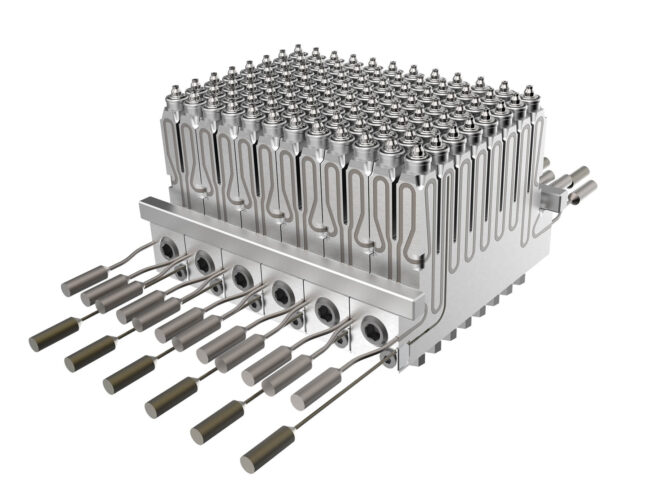
The needle guide made of wear-resistant material also guarantees a permanently high injection point quality and a long service life in continuous operation. The system is rounded off by a temperature control concept developed together with the mould maker, which enables precise coordination between the mould and hot runner components.
With this technological development, GÜNTHER Heisskanaltechnik underlines its innovation leadership in precision injection moulding technology – and offers future-proof solutions for the increasing demands of miniaturisation and multi-cavity production.