

–Sanjay Chavre, Advisor, TAGMA India
Running a toolroom or engineering company? If “ECB” sounds unfamiliar, you’re missing a game-changing financing option that’s just gotten even more accessible for Indian manufacturers.
What is ECB?
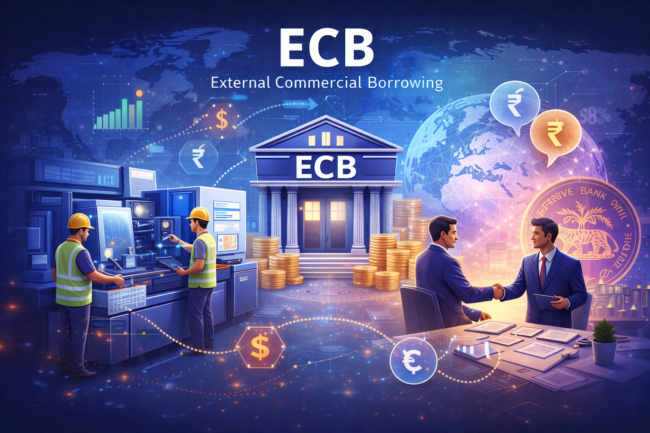
External Commercial Borrowing (ECB) allows Indian companies to raise loans from non-resident lenders—either in foreign currency or Indian rupees—under the Reserve Bank of India’s (RBI) policy framework
Key Changes in February 2026
In February 2026, the RBI overhauled the ECB regime through the Foreign Exchange Management (Borrowing and Lending) (First Amendment) Regulations, 2026, along with a covering A.P. (DIR) Circular to authorised dealer banks. This shift emphasizes market-driven pricing, expanded headroom, and clearer rules.
Updates and Their Impact on Tooling Manufacturing
Eligible borrowers can now raise ECB up to the higher of USD 1 billion outstanding or 300% of net worth (excluding non-fund facilities and mandatorily convertible securities), replacing a rigid annual cap and tying capacity to financial strength. The RBI eliminated the generic all-in-cost cap in favour of market-determined pricing, while setting a minimum average maturity period (MAMP) of 3 years, with a manufacturing-specific carve-out allowing 1–3 year tenors up to specified limits, provided short-tenor costs align with trade credit ceilings. Reporting and end-use restrictions have also been streamlined and clarified in the updated Regulations and Master Direction.
Rising Adoption Trends
These reforms come as Indian firms increasingly tap overseas funding: ECB registrations reached about USD 61.18 billion in FY25, up from USD 48.81 billion in FY24 and USD 25.98 billion in FY23, driven by capital expenditure (capex), refinancing, and on-lending tied to capex.
ECB Primer for Toolmakers
Running a toolroom? ECB just became your flexible funding ally—here’s a plain-English breakdown tailored for manufacturers like you.
- What is it? ECB is a loan (or bond-like instruments such as Foreign Currency Convertible Bonds (FCCB) or Foreign Currency Exchangeable Bonds (FCEB)) from a recognized overseas lender or an IFSC-based financial institution to an eligible Indian borrower (any person resident in India other than an individual), for permitted purposes; you transact and report through a Designated AD Category-I bank.
- How much and how long? Up to the higher of USD 1 billion or 300% of net worth; minimum average maturity period (MAMP) is 3 years, with a 1–3 year window available to manufacturers up to a defined amount; costs under 3 years must meet trade credit (TC) ceilings.
- What can’t you do? RBI’s negative list (Reg. 3A) still bars uses like chit funds, nidhi companies, certain real-estate or farmhouse activities, Transferable Development Rights (TDR) trading, and on-lending to restricted purposes; key clarifications include permitting acquisition of control as an end-use, subject to conditions.
India vs. Best-Practice Markets
India’s 2026 ECB reforms—market-led pricing, net-worth-linked limits, and clearer rules—bring it closer to advanced markets like Singapore and the UK, where central-bank pre-approvals and end-use negative lists are absent.
Advanced markets focus regulation on licensing, consumer protection, and prudential norms, with fully market-driven pricing. India’s updates align toward that template while retaining safeguards suited to an emerging-market context.
Tooling’s Cost Challenge
Indian toolrooms lag global peers with higher blended industrial finance costs, driven by hedging expenses, mid-market credit risk perceptions, and drawn-out processing plus compliance hurdles.
RBI data indicates weighted average margins over reference rates have declined amid easing funding conditions, yet domestic credit benchmarks and hedging premia keep all-in costs elevated for MSMEs.
ECB’s Targeted Edge
This gap is where ECB fine-tuning shines—offering relief without compromising prudence.
ECB interest rates are declining continuously; in February 2026, they were quoted at 5.25% which is about 3% below Indian commercial banks’ lending rates. However, post-hedge all-in ECB costs in India land near 9.3–9.8% before agency/legal fees similar to secured INR loans for many mid-market MSMEs.
When ECB Wins for CAPEX
ECB remains competitive for tooling capital expenditure (CAPEX) if firms secure tight spreads and/or leverage natural FX hedges.
Best scenarios: Large CAPEX projects with FX revenues make ECB equal to or better than INR loans with tight spreads; full hedging adds ~2.5% p.a.
Reforms Needed for Tooling Sector
Indian toolmakers stand to gain big from targeted RBI and GoI tweaks to the ECB route—here’s what incremental reforms could unlock for MSME capex.
Key Incremental Reforms
- MSME “Fast-Track” ECB up to USD 5–10 million: Create a standardised, model-document path—through AD banks and IFSC lenders—for manufacturing MSMEs seeking small-ticket capex loans, with template covenants, simplified security norms, and a time-bound LRN/approval workflow. This reduces frictional costs without changing the underlying regulatory guardrails. (The A.P. (DIR) circular already rationalises where the rules live; fast-tracking is an operational add-on.)
- Pooled, low-spread hedging for exporters via IFSC: Encourage AD banks to offer pooled hedging programmes (for MSMEs with export receivables) on IFSC platforms, cutting per-unit hedging spreads and margin calls. The IMF’s institutional view emphasises pre-emptive tools against FX-mismatch risks; making hedging cheaper and more accessible aligns with that stability logic and lowers all-in borrowing costs.
- Publish a practical “green-list” of permitted manufacturing capex: Within Reg. 3A’s framework, RBI could append illustrative capex examples—e.g., 5-axis machines, EDMs, CMMs, hot-runner hot-halves, mould bases, industrial software & metrology—to reduce interpretational delays at branch level. The rule stays the same, but execution becomes faster and uniform nationwide.
- Auto-reconciling ECB reporting with import data: Integrate ECB-2 reporting with IDPMS/EDPMS so import invoices, LC numbers and installation certificates auto-populate end-use sections—lightening MSME compliance while strengthening data quality for supervisors. (The 2026 circular already consolidated responsibilities; this would digitise them further.)
- Price-discovery transparency: A simple, anonymised “ECB pricing dashboard” on RBI’s data portal (median spreads by tenor/currency & sector) would help MSMEs negotiate fairer terms and reduce information asymmetry, complementing monthly ECB disclosures.
Transformative Reforms
To close the cost gap with global peers and make ECB a practical, cost-effective alternative to domestic lending, bolder reforms could supercharge Indian tooling MSMEs.
Proposed Game-Changers
A) ECB-backed capex credit lines for NBFCs in IFSC: Permit IFSC NBFCs/banks to raise warehouse ECB lines and on-lend exclusively for manufacturing capex under strict ring-fencing (end-use verification, minimum hedge, tenor matching). RBI has already clarified certain on-lending permissions and end-use boundaries; a purpose-built window could scale delivery to clusters like Pune, Chennai, Rajkot, NCR while keeping risks contained.
B) Risk-sharing for hedging: Pilot a partial-credit guarantee (or fee rebate) for MSMEs that maintain documented hedge discipline. Global research shows that capital-account frictions and FX risks can raise spreads; a calibrated backstop lowers risk premia without subsidising interest. Covering ECB hedging through CGTMSE by the Govt for CAPEX/OPEX lending—similar to domestic lending—will be a workable solution, substantially bringing down hedging costs and making ECB viable for most MSMEs. The Government can also negotiate this instrument in bilateral FTAs/Regional Agreements for Indian purchases of CAPEX from these countries/regions.
C) Currency-switch with performance triggers: Operationalise Reg. 3(2) (currency change) via standard AD playbooks that allow INR↔FCY switches when objective triggers are met (e.g., export hedges achieved, DSCR thresholds), cutting legal time and adviser costs for smaller borrowers.
D) An “MSME Manufacturing” automatic route envelope: Consider an automatic-route sub-limit specifically for manufacturing MSMEs tied to capex-to-sales and net-worth thresholds, within the overarching 300% net-worth cap—akin to how advanced markets rely on market discipline and disclosure rather than granular central approvals.
E) International benchmarking & openness scorecard: Publish an ECB openness & efficiency scorecard (turnaround times, pricing dispersion, hedge uptake) against peer jurisdictions. OECD and IMF work repeatedly underline that openness and predictable frameworks attract cheaper capital; public benchmarking will sustain reform momentum and help Indian MSMEs converge to global best practice.
Why These Reforms Are Reasonable
Indian tooling MSMEs need ECB access without the red tape—here’s why these targeted asks make perfect sense for RBI and GoI.
- They preserve prudence: None of the above demands dilute Reg. 3A’s negative list, MAMP, or reporting discipline; they target frictions rather than foundational safeguards.
- They mirror global norms: Advanced markets allow market-led pricing and rely on institutional plumbing (disclosure, prudential oversight) over granular pre-approvals; India’s 2026 move is already in that direction.
- They directly lower MSME costs: Reducing hedging spreads, standardising documents, and improving price discovery attack the actual wedge between an MSME’s quoted ECB rate and the rate a top-tier corporate achieves. Recent RBI/press data around weighted margins and shifting funding conditions show why this wedge matters.
Actionable Steps for Toolrooms
Ready to tap ECB today? Toolrooms can start smart by aligning funding with your export-driven reality for immediate gains.
- Map currency to revenues: If you export moulds, start in USD/EUR and hedge; permit a later INR↔FCY switch as your order book evolves.
- Use IFSC competition: Seek term-sheets from both global banks and GIFT City lenders; compare all-in (spread + fees + hedge), not just headline rates.
- Lock reporting hygiene: File ECB-1/ECB-2 on time through your AD; keep end-use documentation audit-ready to speed future borrowings.
Closing Note for MSME Tooling Units
The new ECB framework puts global capital within reach: bigger limits, market pricing, IFSC access, and clearer rules make it more accessible than ever.
For MSMEs, achieving best-in-class costs requires incremental fixes like fast-track approvals, pooled hedging, and green-lists—plus transformative enablers such as IFSC warehouse lines, hedge risk-sharing, and automatic-route envelopes.
But you don’t have to wait. With a solid capex plan, sensible hedging, and a cooperative AD bank, toolrooms can already finance 5-axis machines, EDMs, metrology, and hot-runner systems—the assets that boost yield, precision, and delivery for world-class operations.
That’s how Indian die & mould makers turn policy reform into durable shop-floor competitiveness. TAGMA can play a key role as information provider and facilitator, including empanelling ECB consultants on negotiated service terms and conditions.

About the Author
Sanjay Chavre is Advisor to TAGMA India.
A respected technocrat and policy strategist, Mr. Chavre has been a pivotal figure in the evolution of India’s manufacturing and tooling ecosystem. With decades of experience at the intersection of government and industry, he has contributed to the development of forward-looking policies that promote indigenous technology, strengthen domestic capabilities, and uplift MSMEs within the tooling and precision engineering sectors.
Mr. Chavre has held key roles in various government departments. He has been instrumental in formulating and executing initiatives that align with India’s long-term vision for industrial growth and self-reliance. His expertise lies in enabling public-private collaboration, fostering innovation ecosystems, and building frameworks that support sustainable industrial development.
In his current role as Advisor to TAGMA India, he continues to guide efforts aimed at enhancing the global competitiveness of Indian toolmakers. His insights have been vital in positioning the Indian tooling industry as a reliable and technologically advanced partner in the global supply chain.
This article was published in TAGMA Times

COMMENTS