



“DMI 2026 brings together the entire tooling ecosystem in one place. It allows companies to demonstrate their capabilities directly to decision-makers. For LMW, it is an opportunity to engage with customers looking for precision, reliable and consistent machining solutions. It also provides visibility to new developments and helps benchmark against industry standards. Overall, it is a good platform for both business and knowledge exchange,” says Shashank Joshi, Head-Sales, LMW Limited., in an interview for the 14th Die & Mould India International Exhibition 2026.
What key trends, challenges, or growth opportunities do you see in the Indian die and mould industry today, and how might they evolve by 2026?
The Indian die and mould industry is seeing steady growth driven by higher demand for precision components and shorter product cycles. Customers expect better accuracy, faster turnaround, and consistent quality.
Challenges include skilled manpower, cost pressure, and technology adoption. By 2026, machine shops that invest in automation, process control, and reliable machines will be better positioned to grow.
Additionally, there is a visible shift towards reducing dependency on imports and improving in-house capabilities. Many tool rooms are also focusing on reducing cycle times to stay competitive. Overall, consistency and process reliability are becoming more important than just machine capability.
Which sectors (e.g., Automotive, EVs, Aerospace, Medical, Defence etc.) are driving demand for Dies and Moulds, and what opportunities do they present for the industry?
Automotive and EVs continue to be the major drivers, especially for high-volume and precision tooling. EVs in particular are bringing new part designs and materials, which require different tooling approaches. Aerospace, Medical, and Defence are growing segments with higher accuracy requirements for die mould applications. These sectors demand consistency, repeatability, and complex machining capability, creating opportunities for advanced machine tools.
How is India’s manufacturing push (e.g., Make in India, China+1) impacting the die and mould sector overall?
The push for local manufacturing and supply chain diversification is creating more opportunities for Indian tool rooms. Customers are increasingly looking for local sourcing of dies and moulds, which is driving investments in capacity, quality, and technology across the industry. This shift is also encouraging companies to upgrade their infrastructure to meet global standards. As more global OEMs look at India as a sourcing hub, consistency and delivery reliability are becoming key focus areas.
What innovations or technologies (e.g., additive manufacturing, AI, simulations) are shaping the competitiveness of the die and mould industry?
Simulation, CAD/CAM integration, and process planning tools are already widely used. Additive manufacturing is emerging for prototyping and inserts. Cost per component in dies and moulds is high, so processes need to be error-free, and simulation plays a key role in achieving this by reducing trial and rework.
From a machine tool perspective, stability, thermal control, and automation integration are key to improving productivity and reducing rework. Digital monitoring and data-driven decisions are gaining importance on the shop floor. These technologies help in better planning, reduced trial runs, and improved overall efficiency.
What role do initiatives like precision manufacturing and talent development play in expanding the die and mould industry into new markets?
Precision manufacturing is essential to meet global quality standards. Without it, entering high-value sectors is difficult. At the same time, operator skill and training play a major role. Even with good machines, output depends on how effectively they are used. There is a growing need for continuous skill development, especially in handling advanced machines and software. Companies that invest in both technology and people will see better long-term results.
How has participating in past DMI exhibitions contributed to growth, networking, or collaborations within the tooling ecosystem?
DMI has helped in connecting with serious customers from tool rooms and OEMs. It provides a focused platform to understand market needs and showcase capabilities. It has also helped in building long-term relationships rather than just short-term leads. In many cases, discussions initiated at DMI have converted into business over time. It also gives a good understanding of industry expectations and evolving requirements.
What makes DMI 2026 a valuable platform for the die and mould industry to showcase its strengths to domestic or global customers?
DMI 2026 brings together the entire tooling ecosystem in one place. It allows companies to demonstrate their capabilities directly to decision-makers. For LMW, it is an opportunity to engage with customers looking for precision, reliable and consistent machining solutions. It also provides visibility to new developments and helps benchmark against industry standards. Overall, it is a good platform for both business and knowledge exchange.
What products, technologies, or launches are you planning to showcase at DMI 2026, and why are they significant for the industry? (Please share the description of the product and share product image.)
We plan to showcase compact, productive and high-speed VMCs with 12,000 & 24,000 rpm for Toolroom/ Die mould applications. Compact turning and turn-mill centres, for industries like Fittings, Auto Components along with application-focused solutions. These machines are designed to deliver high precision, better surface finish, and consistent performance within a compact footprint.
Significant products that will be showcased in the Die & Mould India International Exhibition 2026 include:-
JD1 – High Speed Compact VMC:
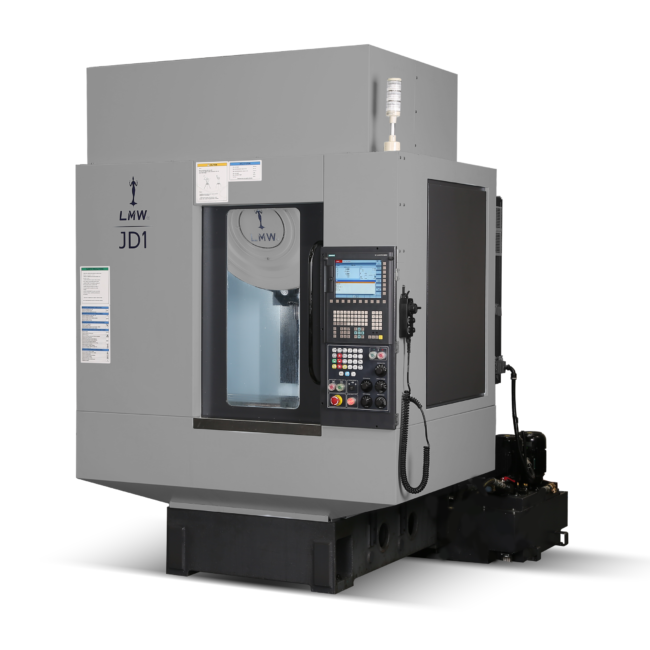
JD1 is a high speed compact Vertical Machining Center. It has a stroke capability of 500 mm on the X-axis, 400 mm on the Y-axis and 320 mm on the Z-axis. It also boasts a spacious pallet size of 650 mm x 400 mm, allowing for efficient handling of the materials, this machine is designed to deliver superior performance and precision. It features a rigid structure that provides a wider working area, allowing for greater flexibility and precision.
With a direct drive BBT 30 high speed spindle upto 24,000 rpm, this machine can deliver unparalleled performance and accuracy. The high-speed pocket tilting automatic tool changer ensures smooth and seamless tool changes, while the high rapid transverse rates of 48 m/min enable efficient and speedy movements of the machine.
Its advanced design ensures exceptional precision and efficiency in the production of high-quality components for Automobile, Electric Vehicle, Die & Mould and Electronic segments.
JD4 – Compact Vertical Machining Center:
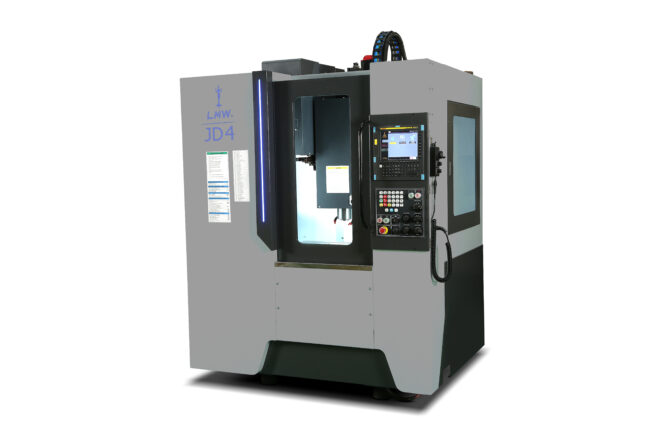
JD4 Compact Vertical Machining Center is engineered to deliver high-speed, high-precision machining within a compact and space-efficient footprint. Designed to meet the needs of modern manufacturing environments, it offers an optimal balance of performance, reliability, and flexibility.
With a stroke range of 500 mm on the X-axis, 400 mm on the Y-axis, and 450 mm on the Z-axis, along with a 650 × 400 mm table, the JD4 provides ample working capacity for a wide range of components. Its 6000 rpm spindle ensures efficient material removal while maintaining excellent surface finish and dimensional accuracy.
The machine is equipped with a fast tool change system that minimizes idle time making it ideal for high-mix and batch production. Built with a rigid structure and designed for consistent performance, the JD4 enables stable machining for demanding applications.
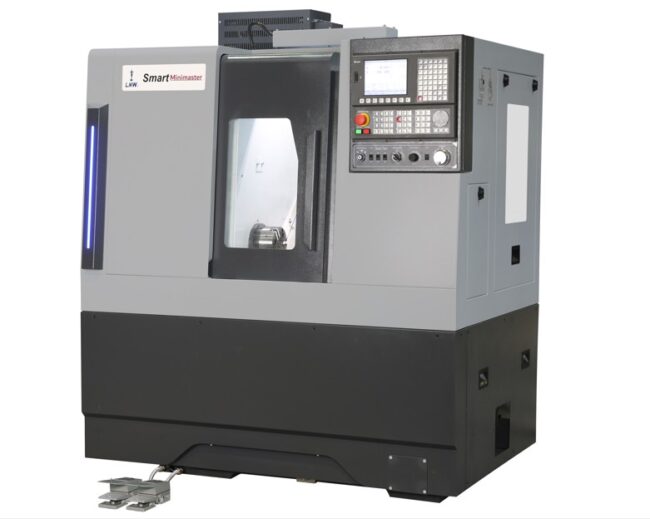
Smart Minimaster – Ultra Compact Turning Center:
Smart Minimaster comes with 5” chuck, 6000rpm Spindle speed, 3.7/5.5 kW power. Occupying a 1.77 Sqm floor space, this is a value for money product for small part turning to meet high volume industry requirements. The Smart Minimaster like any LMW product comes with the highest quality, assured uptime and consistency in components being produced. The Smart Minimaster is another best-in-class machine. A perfect choice for precision machining requirements for industries such as fittings, connectors, bearings etc. As the name suggests a true mini master.
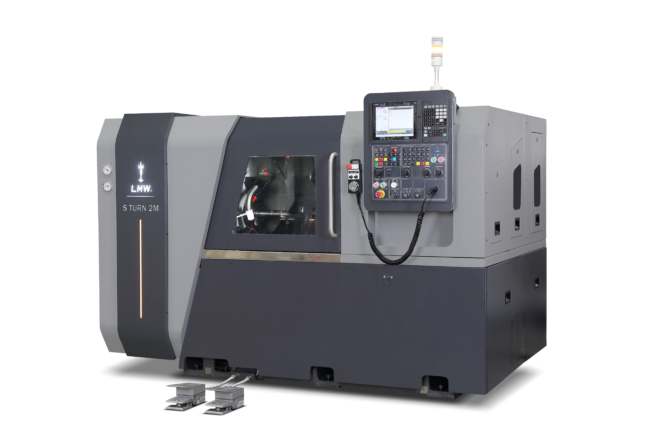
S Turn 2M – 3-axis Turnmill Center:
S Turn 2M – 3-axis Turnmill Center is a versatile solution with a maximum turning length of 400 mm, a turning diameter of 320 mm, and a 200 mm chuck size. It is equipped with 12-station live tool turret, a rotary tool speed of 6000 rpm, with tool change time of 0.7 seconds, and a C-axis (spindle positioning) which consolidates turning and milling into a single setup, offering significant precision, efficiency, and reliability. Its criticality stems from its ability to produce complex components in one, or very few, operations. This machine is suited for Automobile, Electronics, Aerospace, Energy, Oil & Gas industries.

COMMENTS