


-Sudhanshu Nayak
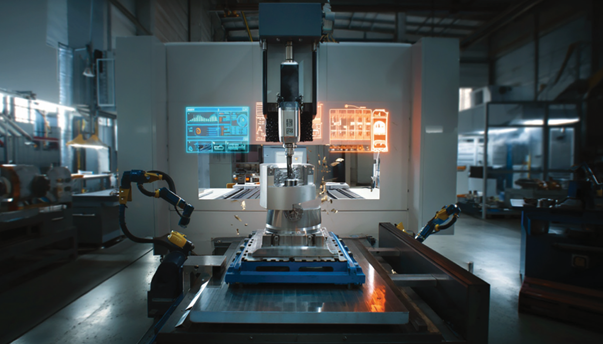
“Zero-Touch” machining marks a new phase in manufacturing, where tools, machines, and AI seamlessly work together. By utilising advanced machining methods and data, die and mould makers are making processes more consistent and predictable. As tolerances tighten and materials get harder, success depends not just on the tools, but on the data and intelligence behind them. This article highlights how AI-integrated tooling and advanced geometries are redefining precision for die and mould shops in 2026.
The die and mould industry operates in an unforgiving reality where the margin for error has effectively vanished. Driven by the stringent demands of the electric vehicle segment, 62 which requires massive, complex moulds for lightweight structural components, and the micro-precision requirements of medical device manufacturing, shops are routinely tasked with machining cavities in tool steels hardened well beyond 60 HRC. In this high-stakes environment, the traditional reliance on operator intuition and the “machining as a craft” paradigm are rapidly giving way to predictive precision. The ultimate objective for the modern die and mould shop is the “Zero-Touch” machining. The “Zero-Touch” machining refers to a methodology wherein a high-value block of hardened steel is loaded into a multi-axis machining centre and emerges as a finished cavity with zero manual intervention, zero scrapped parts, and zero catastrophic tool failures. Achieving this cyber-physical manufacturing vision requires synchronising highly advanced cutting tool geometries with real-time sensor integration and artificial intelligence.
Milling: Dynamics of High-Feed Kinematics and Thermal Barriers
When it comes to roughing and semi-finishing hardened tool steels, high-feed milling has fundamentally rewritten the rules of metal removal by exploiting the physics of radial chip thinning. Traditional milling strategies often struggled with excessive radial forces that induced regenerative chatter, leading to premature flank wear, micro chipping at the cutting edge, and poor surface finishes. To combat this, modern tooling engineers have developed high-feed geometries designed with exceptionally low lead angles. This specific geometry directs cutting forces axially up into the machine spindle, the most rigid component of the machine tool, rather than radially against the side of the tool, minimising deflection. By taking highly shallow depths of cut combined with aggressively high feed rates, the heat generated in the primary shear zone is transferred almost entirely into the chip rather than the tool substrate or the workpiece.
To quantify and optimise this method, CNC programmers rely on the equivalent chip thickness formula, where the actual chip thickness depends on the feed per tooth, the radial depth of cut, and the cutter diameter. Pushing these physical boundaries safely in 65 HRC steel requires more than just optimised geometry; it requires advanced materials and real-time data. Modern end mills utilise high-aluminium-content physical vapor deposition (PVD) coatings, such as Aluminium Chromium Nitride (AlCrN), applied in nanometer-thick alternating layers. These coatings act as formidable thermal barriers and feature high residual compressive stress to prevent crack propagation. Furthermore, sensor-integrated tool holders equipped with piezoelectric accelerometers monitor high frequency harmonic vibrations at the spindle interface. If the system detects the microscopic acoustic emissions that precede catastrophic tool breakage, the integrated AI algorithms communicate via ultra-low latency protocols to instantly override and optimise the feed rate, ensuring the cutter survives the duration of the toolpath.
Turning: Hard Turning Tribology as a Grinding Alternative
While milling commands the spotlight for complex 3D cavity work, turning operations are undergoing a parallel revolution in the production of core pins, ejector pins, and guide bushings. Historically, achieving tight dimensional tolerances and mirror like surface finishes on hardened cylindrical components required slow, messy, and environmentally taxing cylindrical grinding operations. Today, hard turning is aggressively displacing grinding as the premier finishing method. This process leverages the immense static and dynamic stiffness of modern lathes combined with the extreme hot hardness of Polycrystalline Cubic Boron Nitride (PCBN) cutting inserts. The physics of hard turning are highly counterintuitive. The operation relies on generating enough localised heat ahead of the cutting edge to momentarily plasticise the metal in the primary shear zone. This thermal softening effect allows the PCBN edge to cleanly peel away the material before the heat can conduct into the core pin itself, resulting in exceptional dimensional stability and preventing the introduction of subsurface residual tensile stresses often caused by aggressive grinding.
The exact formulation of the PCBN insert is critical to this success. Machining continuous cuts in hardened steel requires low-CBN-content inserts with titanium-based ceramic binders to combat chemical crater wear, whereas interrupted cuts require high-CBN-content for maximum fracture toughness. Furthermore, the integration of specialised wiper geometries on these inserts has been a transformative development. Wiper inserts feature a complex blend of radii that create a slightly flattened leading edge, effectively ironing the workpiece as it cuts. This kinematic advantage allows machinists to double their feed rates while still achieving surface finishes. By replacing a multi-hour grinding setup with a rapid hard-turning cycle, die and mould makers drastically reduce their lead times while entirely eliminating hazardous grinding swarf from their shopfloors.
Hole-Making: Fluid Dynamics in Deep-Hole Micro-Drilling
Thermal management dictates the cycle time of an injection mould, making the design of cooling channels a highly critical engineering challenge. The industry has largely moved away from straight-line drilled water lines in favour of conformal cooling channels that closely follow the three-dimensional contours of the mould cavity. Reaching deep into large mould bases to intersect these channels requires extreme deep-hole micro-drilling. Drilling into hardened steel at depth-to-diameter ratios of 40xD or greater is fraught with peril, as a broken drill bit seized deep inside a cavity block can instantly ruin a nearly finished mould. To mitigate this, advanced solid carbide deep-hole drills incorporate double-margin designs. Unlike standard single-margin drills, a double-margin drill provides four points of contact within the hole, acting as a continuous guide bushing to ensure flawless straightness and prevent the drill from wandering off center at extreme depths.
The most critical factor in deep-hole drilling of hard materials is chip evacuation and thermal management at the drill point. These specialised drills utilise ultra-high pressure internal coolant channels, pushing cutting fluids at pressures exceeding 1000 psi directly to the cutting edges. This extreme pressure is required to break the vapour phase barrier—a pocket of steam that forms around the cutting edge at high temperatures, which prevents standard coolant from actually lubricating the cut. The high-pressure fluid collapses this vapour barrier, quenches the cutting edge, and blasts the chips back up the highly polished flutes. To minimise the thrust force required to penetrate 60 HRC steel, these drills utilise flattened point angles, combined with specialised web-thinning techniques that reduce the extrusion action at the chisel edge. Maintaining the correct cutting parameters relies on strict adherence to the surface speed calculation, ensuring the tool operates strictly within its engineered thermal window.
Threading: Risk Mitigation through Helical Interpolation
In the chronological workflow of mould making, threading is typically the final machining operation, making it the highest-risk procedure. Synchronous tapping into a hardened mould component induces a profound level of anxiety for the machine operator. Standard solid carbide taps rely on sheer torque to force their way into the material, creating immense radial pressure and continuous chip-packing. If a tap binds and shatters inside a blind hole, extracting the hardened fragments requires a notoriously difficult and time-consuming electrical discharge machining (EDM) process. To eliminate this final-stage risk and protect the “Zero-Touch” methodology, the industry is widely adopting orbital thread milling.
Thread milling changes the kinematics of internal threading entirely by utilising helical interpolation. Instead of driving a tool straight down the hole along the Z-axis, a thread mill, which is significantly smaller than the minor diameter of the thread, uses synchronised circular motion in the X and Y axes while simultaneously feeding along the Z-axis to carve the thread profile into the wall. Because the tool only engages a small percentage of the material at any given time, radial cutting forces and spindle torque are dramatically reduced. Furthermore, thread milling allows for climb milling in hardened materials. This means that the cutting edge enters the material at maximum chip thickness and exits at zero, which minimises rubbing and drastically reduces rapid flank wear. Most importantly, it provides absolute security. If a thread mill reaches the end of its tool life and suffers catastrophic failure, the tool shank remains smaller than the hole. It simply falls loose and can be extracted effortlessly, leaving the workpiece unharmed and ready for a replacement tool to seamlessly resume the toolpath.
Conclusion: The Convergence of Physics and Data
The transition to “Zero Touch” machining represents a fundamental evolution in manufacturing philosophy. It is not merely about purchasing harder carbide substrates; it is about embracing an ecosystem where cutting tool physics, machine tool kinematics, and artificial intelligence operate in closed-loop communication. By leveraging the specific geometric advantages of high-feed milling, the tribological properties of PCBN hard turning, the engineered fluid dynamics of deep-hole drilling, and the low-force kinematics of thread milling, today’s die and mould makers are engineering absolute certainty into a traditionally unpredictable process. As component tolerances tighten and material hardness continues to increase, the most valuable asset on the shopfloor is no longer just the physical cutting edge, but the predictive, scientific data driving it.
This article was taken in TAGMA Times Magazine

COMMENTS