
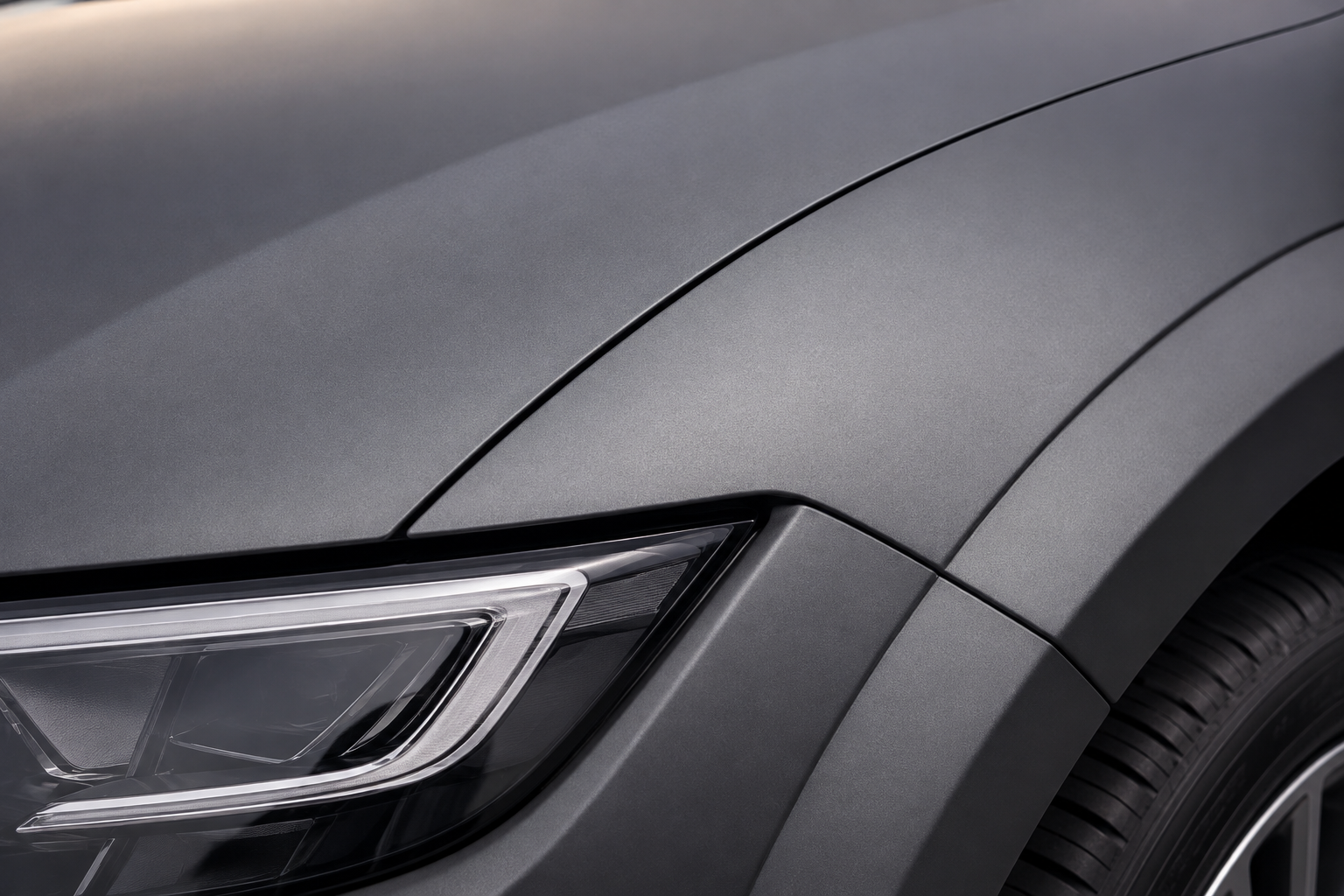
Two parts can have the same geometry, material, and even wall thickness but require two completely distinct moulding processes. The reason usually comes down to a single line on the drawing: surface finish.
Most teams view gloss or matte appearance as a finishing touch, something done after the mould has been produced. In practice, the required finish influences decisions from the first design review, including cavity and core surface preparation, draft angle, parting line, and gate placement. Change the finish, and you’ll frequently change the tool.
What “Gloss” and “Matte” Actually Mean to a Toolmaker
“High-gloss” and “matte” aren’t just two points on a roughness scale, they’re two different manufacturing goals.
High gloss is about controlled reflection from an extremely smooth cavity surface. Matte, on the other hand, usually comes from an engineered texture, a defined pattern with its own depth, direction, and repeatability. “Matte” without a texture standard or acceptance method is not a specification; it’s a guess that the toolroom has to interpret.
Manufacturing Mould for “Gloss” vs “Matte”
For a gloss finish, the mouldmaker’s job is to remove irregularity. The CNC technique must avoid obvious tool marks, EDM surfaces frequently require progressive polishing, and steel cleanliness is crucial since any inclusion, pit, or EDM damage will show up beneath a mirror finish.
To achieve a textured finish, the mouldmaker purposefully applies a regulated surface pattern using chemical etching, laser texturing, or similar procedures onto a previously prepared base surface. Skipping that preparation results in an uneven texture afterward. Neither route is necessarily easier. They’re simply solving opposite problems.
The Hidden Design Change for Ejection
Here’s where most teams get caught out. A smooth, high-gloss surface can often work with a fairly standard draft. A textured surface changes that equation; deeper grain effectively increases the mechanical engagement between the moulded part and the cavity wall.
A vertical cosmetic wall that releases cleanly at 0.5° draft in a smooth finish can become a real ejection problem once a deeper grain is specified. Ribs, bosses, and recessed features are especially sensitive to this. There’s no universal “minimum draft” number here; the right angle depends on texture depth, material, and local geometry, but the underlying rule holds: texture depth and draft are directly connected decisions, not separate ones.
Texture Doesn’t Make Tooling Easier, It Moves the Difficulty
It’s tempting to assume matte parts are simpler because machining marks don’t show. That’s only half true. Texture may hide some flaws, but it cannot compensate for poor surface preparation, and it presents its own risks: uneven application near sharp transitions, increased draft requirements, and costly rework if the texture must be removed and applied again.
Gloss requires surface perfection – simply a consistent shiny surface along the whole part, a mould surface as flawless and uniform as possible with no marks, no pits, and no inconsistency. Texture necessitates surface control – a deliberately applied, consistent pattern. The challenge simply appears at a different location.
When Looks Matter, Geometry Matters More
Once a surface is cosmetic, parting lines, gate vestige, and ejector marks stop being purely functional decisions, they become visible ones. Sharp internal corners are hard to polish evenly. Deep, narrow cavities are hard to texture consistently. This is why parting-line selection and gate placement need to be reviewed with the finish requirement in hand, not decided independently and adjusted later.
The Expensive Scenario: Changing Finish Mid-Project
This is where the real cost shows up for toolmakers.
A late switch from matte to gloss can mean removing texture, re-machining, deeper polishing, and even redesigning draft if the original texture demanded extra clearance. Going the other way, gloss to matte means checking whether existing draft and thin-wall sections can even tolerate a texture at all. The expensive part is rarely the finish itself. It’s discovering the tool was designed for a different part.
Which Finish Is Actually Harder to Tool?
The honest answer is that it relies on the part, not the finish label. A strongly textured deep cavity can be more difficult to build consistently than a smooth polished one. High gloss makes faults easier to see, whereas texture might make process variation more difficult to detect until manufacturing is underway. The true question isn’t “which finish is harder”; it’s which finish poses the most surface, geometry, and inspection constraints for this specific part.
Where high gloss tends to struggle:
- Any steel or EDM defect becomes immediately visible
- Sharp internal corners are hard to polish evenly
- Parting lines, gate vestige, and ejector marks are far less forgiving
- Rework (re-polishing) is slow and labour-intensive if defects surface late
Where texture tends to struggle:
- Deep cavities and tight corners are hard to texture consistently
- Draft requirements increase, which can force geometry changes
- Uneven texture application is harder to catch during inspection
- Process variation (fill, cooling) can show up as visible texture inconsistency only in production
The ideal way to approach designing for both is to double-check the specific finish requirement, texture depth (if applicable), draft against that texture, cosmetic surface visibility, parting-line placement, steel and hardness suitability, and inspection criteria before releasing a tool design. These are not separate checkboxes; a texture option affects draft, which in turn affects geometry, which in turn affects ejection.
Indian Toolmakers’ Capability on Gloss and Texture Work
Indian tool rooms have progressed well beyond just a low-cost machining solution in this sector. Several Indian mould manufacturers now have in-house CNC and EDM cells capable of Class-A polishing for car interiors and consumer appliance parts, as well as relationships with specialised texture houses for VDI and grain-pattern standards. The most significant improvement is that process discipline steel selection, EDM parameter control, and pre-texture surface prep are now regarded as design-stage decisions rather than finish-stage corrections. For OEMs purchasing tooling from India, the capability difference that mattered a decade ago in terms of consistent cosmetic surface quality has closed significantly, however it still pays to evaluate a supplier’s texturing and polishing track record in addition to their machining capabilities.
The Core Lesson
The mould doesn’t just reproduce a part’s geometry, it reproduces its intended surface condition. Treat finish the way you already treat draft, parting line, and ejection: as a design input from day one, not a finishing operation bolted on at the end.