
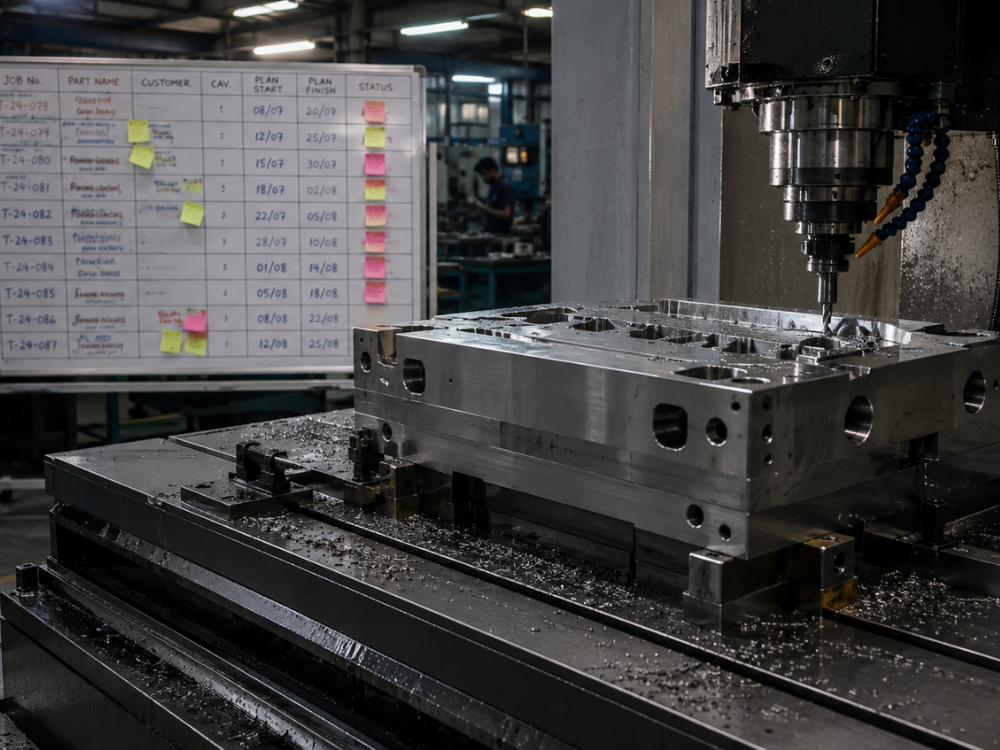
Ask any Indian toolmaker whether delivery matters and you will get the same answer. Of course it matters. Nobody in this business treats a promised date casually. Customers are demanding, competition is close, and a reputation for slipping schedules follows a shop around for years.
So the delivery problem is not a problem of intent.
It is a problem of method.
A large number of Indian toolrooms still run as person-driven job shops. The plan lives in an Excel sheet, a whiteboard, a WhatsApp group and the owner’s head. That works when the shop has six machines and four live jobs. It stops working the moment the shop has twenty machines, fifteen concurrent projects, three subcontractors and a customer who revises the CAD model in week five.
At that point the shop does not need more machines. It needs a planning system.
An industry that cannot afford to be late
The Indian tooling industry is not small. The TAGMA and Nomura Research Institute tooling report put the market at roughly ₹23,600 crore, and TAGMA president D M Sheregar has more recently cited a figure of around ₹23,800 crore. Automotive still drives more than half of that demand, with plastic moulds and sheet metal dies together making up close to eighty per cent of the mix.
The gap sits on the import side. By Sheregar’s own account, around 34 per cent of tooling demand in India is still met through imports, and roughly 80 per cent of those imports come from China, South Korea, Japan and Taiwan.
That is not only a technology gap. Delivery reliability is a large part of it.
A tool that lands two weeks late can hold an OEM’s launch programme, idle an assembly line and push penalty costs far past the value of the tool itself. When the downside is that large, a buyer will pay more and import from a supplier who has never missed. Price stops being the deciding factor. Confidence in the date becomes the deciding factor.
Which turns the real question around. The question is not whether an Indian toolroom can build the tool. Most can, and many build tools that are technically better than what is being imported. The question is whether the shop can plan it, sequence it, absorb the disruptions and still hit the date it committed to eight weeks earlier.
Toolmaking breaks the rules that normal planning assumes
Production planning software was built for repetition. Make the same part ten thousand times, learn the cycle time, and the schedule becomes reliable.
A toolroom does the opposite. It may build a particular mould exactly once. Every project brings a new geometry, a different steel, a different tolerance stack, a different electrode count, a different heat treatment cycle and a tryout that nobody can time precisely in advance.
Variability is not a defect in toolmaking. It is the nature of the work.
The failure is planning that variable work with a method that assumes stability. A job gets quoted. A date gets promised. Operations go into a spreadsheet. Machines get allocated on the basis of what looks free.
Then the shop floor happens.
The wire cut goes down. The steel arrives four days late. The customer sends a revised model with a changed parting line. The electrode is not finished. Heat treatment takes an extra shift. The best programmer is stuck on another job. A rush order walks in from the biggest customer and cannot be refused.
One delay does not stay one delay. It moves every dependent operation behind it, and every job those operations were sharing a machine with.
This is the weakness of planning on infinite capacity. The plan quietly assumes the resource will be free when the job reaches it. The shop has a fixed number of machines, operators, fixtures and hours in a shift. When the two diverge, nothing recalculates automatically. Somebody picks up the phone, opens the sheet, drags a few dates and starts firefighting.
The schedule survives.
The delivery date does not.
Where the days actually disappear
The same handful of causes show up across shop after shop.
Planning data arrives late or wrong. Material status, CAD revisions, BOMs and job progress sit with different people in different formats. Sequencing built on unreliable data is unreliable by definition.
Machine availability gets misread. A machine can be idle and still unavailable, because it is waiting for a fixture, a programme, an electrode, a cutting tool or an operator with the right skill. Availability on paper is not availability in practice.
Engineering changes hide their cost. A design revision reaches back into programming, machining and sometimes material. Without revision control, nobody can say afterwards how many days it consumed, so the same loss repeats on the next job.
Rework consumes capacity invisibly. A plate that takes two days to machine and one more day to correct has used three days of the shop. If that third day never gets recorded, the estimate for the next similar job stays wrong.
Specialist capacity chokes. Five axis, EDM, high speed machining, CMM inspection. One constrained resource can hold an entire project while everything else waits.
Subcontracting is fragmented. Compared with mature clusters in Taiwan or South Korea, Indian toolmakers work with a thinner and less predictable network for heat treatment, coating, specialised machining and metrology. TAGMA has named the missing outsourcing ecosystem as one of the industry’s main constraints, alongside skilled manpower and finance.
And then the one that is hardest to write into a report. In most small toolrooms, the planning system is a person.
When the owner is the planning system
In a typical shop, the owner quotes the job, plans production, argues with the steel supplier, handles the customer, signs off quality and makes the final technical call on tryout.
It works, and it works surprisingly well, until it does not.
A shop of fifteen people can run on informal coordination for a decade. The owner knows which machine is loaded, which fitter is best on a particular kind of core, which supplier slips, which customer always changes the design at the last minute. That knowledge is real and it is valuable.
The problem is that it is stored in one head. It never becomes a standard routing, a recorded cycle time, a digital job card or a capacity number anybody else can use. So the business cannot grow past the memory of the person running it. The informal system that carried the shop for ten years becomes the ceiling.
This is why India has capable MSMEs that stay deliberately small. Crossing into the next size band demands organisational infrastructure, compliance capacity and working capital that many owners judge, correctly, to be harder than staying where they are. You find shops with excellent machines and serious technical ability, no dedicated planner, no production control function and no digital workflow.
The machines are modern. The planning is not.
Money is part of the delivery problem
Planning and cash are the same conversation.
A toolroom finances the job before it gets paid for it. Steel has to be bought, electrodes made, cutting tools stocked, outside processes paid for, overtime funded when time has to be recovered. TAGMA has repeatedly flagged that Indian tool rooms face a high cost of financing and poor access to capital compared with their global counterparts, and that delayed payments from large customers squeeze working capital further.
Tight cash makes the fix harder to buy. Software, an extra machine, a planning hire, training, all of it gets deferred. Deferring it keeps delivery uncertain. Uncertain delivery weakens the customer’s confidence, which shows up as tougher payment terms and thinner margins, which tightens cash again.
That loop does not break by buying another machine.
What ERP, MES and APS actually do
The answer is not “buy an ERP”, which is where most of these conversations stop. The three layers solve different problems and the value comes from connecting them.
ERP answers what needs to be made. Orders, BOMs, inventory, purchasing, costing, financials.
MES answers what is actually happening. Machine status, job start and finish, operator activity, downtime, scrap, real cycle times from the floor rather than estimates from the quote.
APS answers when it should be made and where. Advanced Planning and Scheduling takes demand from ERP and reality from MES, then schedules against actual constraints. Machine capacity, tooling, fixtures, operator skills, shift patterns, material dates and process dependencies.
That last layer is the one Indian toolrooms are missing most often, and it is the one that changes the answer to a customer.
Infinite capacity planning asks whether a job should be finished by Friday. Finite capacity planning asks whether Friday is achievable given everything else already sitting on the shop floor. Those are completely different questions.
When the rush order arrives, a planner with finite capacity scheduling can model it before accepting it. Which jobs move. Which machine becomes the bottleneck. Which three delivery dates are affected and by how much. Whether another route absorbs it.
That is a conversation with the customer. A spreadsheet only produces a promise.
Start small, and start with visibility
No MSME toolroom needs to implement all of this at once, and the ones that try usually stall.
The sequence that works is boring. Get reliable digital visibility first through ERP and MES. Capture jobs, materials, operations, machine availability and actual times. Then build standard times from what the floor really did, not from what the estimator assumed. Then bring in finite capacity scheduling once there are enough machines, enough concurrent jobs and enough bottlenecks to justify it.
After that, the improvements compound. Machine monitoring feeds real cycle times back into planning. Simulation cuts design and machining iterations. Paperless job cards fix shop floor communication. CAD and BOM integration removes transcription errors. Automated alerts trigger a replan while there is still time to recover, rather than after the date has gone.
The point of all of this is not digitalisation. It is predictability.
A toolroom should be able to tell a customer when the tool will be ready, why that date is achievable, and what happens to it if the customer changes the design in week five.
From toolmakers to system-driven manufacturers
India does not have a shortage of capable toolmakers. It has thousands of tool rooms, captive and commercial, with experienced engineers and increasingly serious equipment. What it has is a shortage of organisational capability, which is a different thing from technical capability.
Closing that needs work on three fronts at once. Planning infrastructure, meaning ERP, MES and finite capacity scheduling. Process infrastructure, meaning documented routings, real standard times, digital job cards, revision control and structured handovers. And cluster infrastructure, meaning dependable shared access to metrology, heat treatment, NDT and specialised machining that no single small shop can justify owning.
Government tool rooms have shown that system discipline is possible in Indian conditions. The commercial side needs to copy the discipline, not only the machine list.
The delivery gap between Indian and international toolrooms is not mainly a technology gap. It is a management system gap.
The shops that close it will not necessarily be the ones with the most expensive five axis machine. They will be the ones that know exactly what is loaded, what is free, what is late, what has changed, and what every delay does to the final date.
For thirty years, Indian toolmaking has used experience to compensate for weak systems. The next thirty will need the reverse. Use systems to capture the experience, make capacity visible, and turn delivery dates from optimistic promises into numbers the shop can stand behind.