
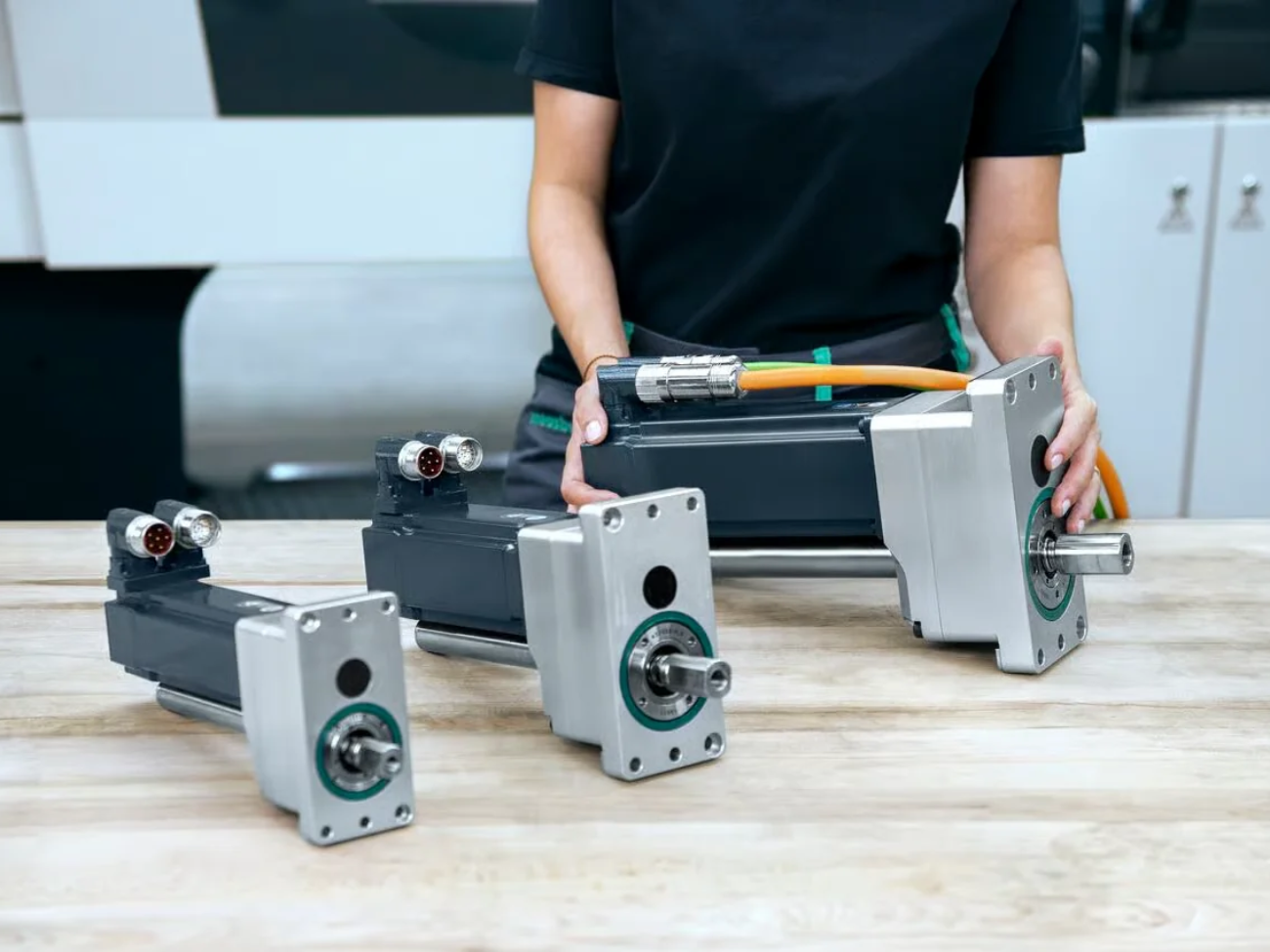
Meusburger has highlighted the growing importance of servo-electric drive solutions in mould and die making, particularly with the increasing adoption of electric injection moulding machines.
Precise movement sequences are essential for maintaining stable production processes and ensuring consistent component quality. Servo-electric drives enable controlled movements with high repeatability, offering an alternative to conventional pneumatic and hydraulic drive systems.
These solutions are particularly suitable for applications that require accurate positioning, dynamic movement and high process reliability. Their use supports precise mould operations and helps meet the growing demands of modern mould and die manufacturing.
Functional principle of servo-electric drives
A servo linear actuator is largely made up of a servo motor, a drive regulator and a mechanical force transmission. The servo motor converts electrical energy into a controlled rotational movement, which is then converted into a precise linear movement, for example via a spindle. An encoder continually monitors the position of the motor shaft and delivers the data to the drive regulator. The continuous comparison of the set point and actual values creates a closed-loop control system, which enables precise positioning and high repeatability.
This continuous feedback ensures high positioning accuracy and repeatability. Especially for complex movements and repetitive production cycles, these are crucial prerequisites for reliable process control.
Advantages for mould and die making
Servo-electric drives offer numerous advantages over pneumatic or hydraulic solutions, particularly when it comes to demanding motion control tasks:
- High precision: Position, speed and motion sequences can be accurately defined and controlled. This allows, for example, slides or cores to be positioned precisely.
- Reproducible processes: Defined motion profiles ensure consistent processes across many production cycles. This supports stable process control.
- Clean drive technology: Servo-electric systems operate without hydraulic oil and therefore avoid potential leaks. This creates clean production conditions and offers advantages for applications with high requirements for cleanliness or cleanroom conditions.
- Dynamic movements: Servo motors enable fast acceleration and braking processes. This enables short movement times to be achieved and provides targeted support for cycle times.
- Efficient energy use: The electrical energy is directly used to generate movement. Depending on the application, this can help to reduce the need for additional energy-intensive auxiliary systems.
- Easy integration: Servo-electric drives can be integrated into existing machine and control systems via suitable interfaces. This allows movements within the mould or die to be precisely synchronised with the machine cycle.