
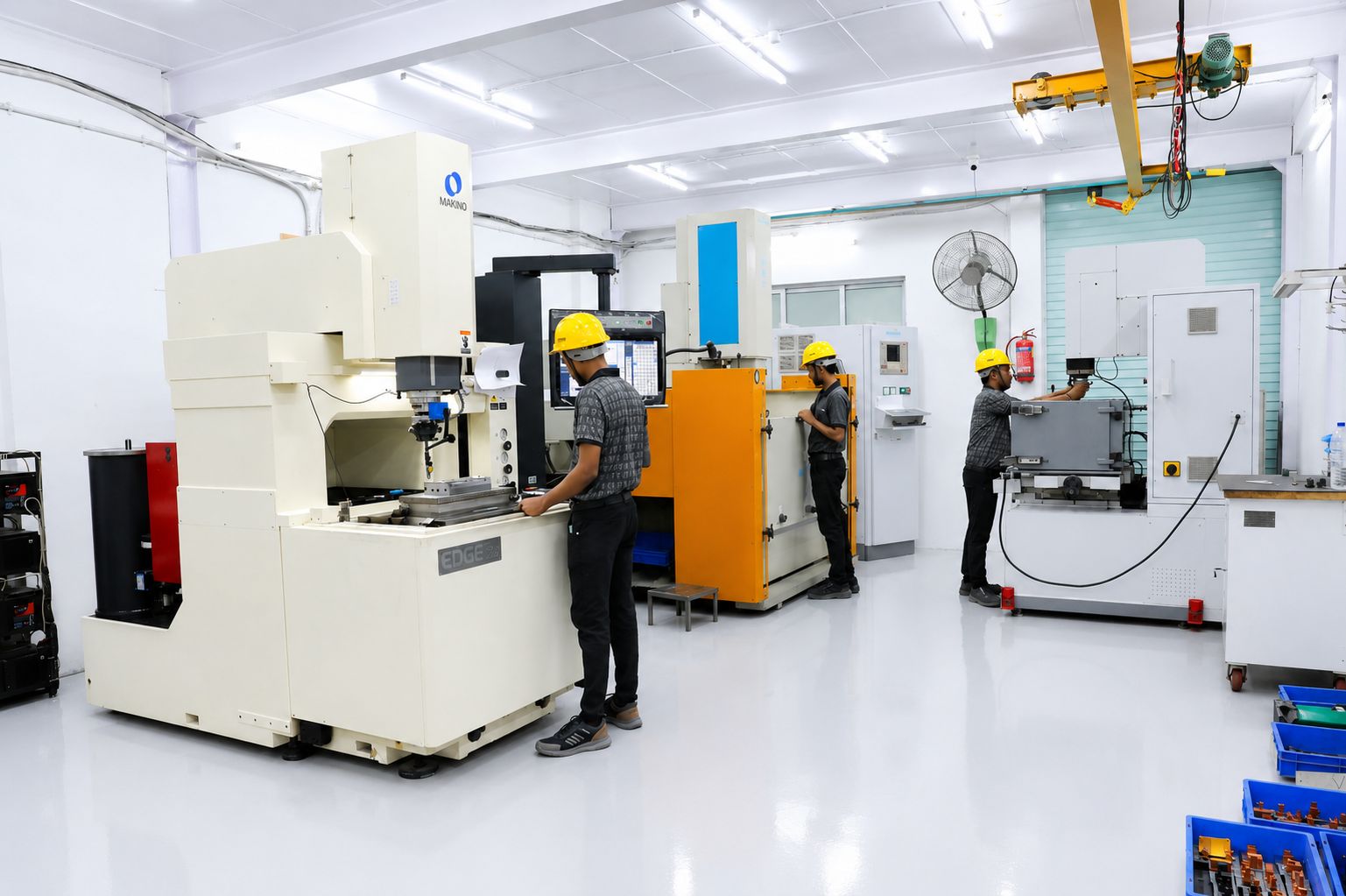
In an industry where corrections and rework are often accepted as part of the job, VJ Precision Molds Pvt. Ltd. is building around a different belief: get every part right before assembly begins. Led by Vijay Chauhan, the company has turned that principle into practice, growing from a single CNC machine in 2022 into a steadily expanding tool room serving customers across multiple sectors.
Some leave a job with an idea of what they want to build. Others leave knowing exactly what they can build, because they have spent years diligently learning every aspect of the business someone else runs. Vijay Chauhan belongs to the latter group.
On January 8, 2022, Vijay parted ways with one of the industry’s reputed companies after 15 years of being at the centre of its operations. There, he not only finalised orders but also managed design feasibility, coordinated tool dispatch, and kept 70-80 moulds and 15-20 customers moving at any given time. When he exited the company to achieve his entrepreneurial vision, all he had was the INR 10 lakh severance package and a plan that, by most conventional measures, should not have worked.
Fast forward to 2026, VJ Precision Molds Pvt. Ltd. (VJ Precision) has delivered 325 moulds, crossed INR 9 crore in annual turnover, and is strategically assembling the infrastructure to serve the electrical, fasteners, medical, and automotive segments simultaneously. But this is not a story about funding or connections; it is a story about what unfolds when two decades of earned skills are finally put to work for oneself.
A 20-Year Journey across Multiple Tool Rooms
After two years of pursuing an ITI course in Mechanical Engineering at SVKM’s Shri Bhagubhai Mafatlal Polytechnic and College of Engineering, without a CIPET or GTTC pedigree, Vijay secured his first job not in tooling, but in moulding. This distinction matters because it shaped his understanding. “Everyone starts with tooling, but I started with moulding. The first two years consisted of applying moulds and conducting trials. I learned what the end of the chain looks like before I could even understand the beginning,” he reminisces.
From Pune, where he began building his foundation in the plastics and moulding industry, he worked at several well-known companies across Mumbai, gaining hands-on experience on the shop floor and deepening his understanding of mould trials, corrections, and production processes. Each phase of his journey added a new layer of technical expertise and practical knowledge in shop floor management and precision tooling. In 2006, he joined another reputed tooling company, where he dedicated the next 15 years of his career, further strengthening his experience and mastery in the field.
In those 15 years, Vijay would leave home at 8 am and return around 10 pm or even midnight. He would work on weekends too. The company gave him more responsibilities than most people his age were ready for. They offered him reasons to stay. “With the job taking up most of my day, I could not spend much time with my family. I could not even spend much time with my daughter; she was barely seven years old. Since I always aspired to become an entrepreneur, starting something of my own felt like the only way to spend time with family and build a future that would outlast a job,” he explains.
The INR 24 Lakh Beginning
To arrange the initial capital, funds were raised through personal assets and savings, totalling approximately INR 24-26 lakhs. Of this, INR 5 lakhs was allocated as a deposit, around INR 2 lakhs was invested in a laptop and essential infrastructure, and the remaining amount was utilised towards booking machinery. “I started with a single CNC machine. My plan was simple: make mould bases. I didn’t want to do anything else. Just that one thing,” he affirms.
The automotive industry was his first instinct. Shaped by years of experience and relationships built over time, he reached out across his network, but the doors didn’t open—the reason: the automotive supply chain has its own logic. Getting onto a vendor panel usually takes one to two years of process, documentation, and approval, regardless of capability. For a company that was only a few months old, this factor left very little room for entry into the system.
His breakthrough came from an unexpected direction: PVC pipes. Companies like Georg Fischer Ltd. and Prince Pipes and Fittings Ltd. needed connectors, elbows, and fittings moulds. They were less concerned with ISO certificates or three-year track records and prioritised timely order completion without compromising on quality. VJ Precision had a machine and a founder who knew mould corrections by instinct — factors which helped the company earn the job.
“PVC was the base we stood on. They gave us work when nobody else would. That is what kept us running in the first year,” he recounts.
The early work also comprised reconditioning, repairing and refurbishing old moulds that had seen better days. It was not glamorous, but it generated revenue, which was reason enough for Vijay to take on the job.
The Precision Philosophy: Mould as Lego
What separates a good tool room from a mediocre one? Vijay’s response is rather unexpected. “If the size is 100% okay, if every part is made exactly as per the 3D model, a mould is just like a Lego set. You assemble it; it works. The reason we need highly skilled people doing corrections, grinding and rework is that the parts were not made to precision in the first place,” he explains.
This is VJ Precision’s operating thesis, and it is more radical than it sounds. In India’s tool room culture, the skilled mould maker has traditionally been someone who knows how to fix things that don’t fit. The craft has evolved around imprecision. But VJ Precision believes that if machining is done right, the skill requirement shifts upstream to programming, setup, and measurement rather than downstream to repair.
This is why the next major investment is a CMM (Coordinate Measuring Machine) from Mitutoyo. The plan is not aspirational; it is operational. “Without a single part being checked by a CMM, we will not assemble the mould. That is the goal. If we have 100% checking at every stage – machining, EDM, core, electrode – we can reject bad parts early rather than discover problems at trial,” he elaborates.
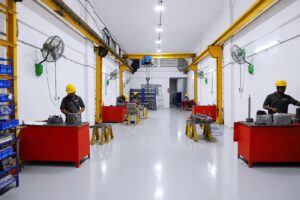
The company has already added inspectors across departments. EDM has one. CNC is getting two more. The reasoning is direct: if there is a traffic constable at the signal, 10 people stop. If not, everyone runs the light.
Building a Culture from Scratch
The machines are the visible part. The harder work, Vijay says, has been building a culture.
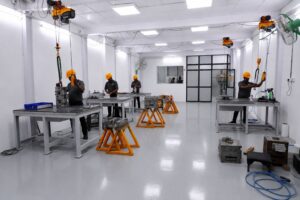
In the early years, getting workers to wear shoes on the shop floor required daily enforcement. Getting three sets of uniforms to actually be used rather than rotated every three days was a fight. The resistance was not malicious; it was unfamiliar. Nobody had expected it from them before.
The philosophy VJ Precision applies is one borrowed from an unlikely metaphor: school. “When a teacher is strict, students don’t appreciate it. But when they grow up, they realise they could achieve their goals because of the discipline instilled by that strictness. It is the same on the shop floor. Once people get used to the good things, they will notice the difference themselves,” he says.
The company now hires fresh trainees and puts them through a calibrated training process. The target is not just skill development but the formation of professional habits, which, once formed, become part of identity rather than something imposed through instruction.
Sonali Chauhan, Vijay’s wife and a Director at VJ Precision, has a progressive vision for the future. She aspires to encourage greater participation of women in the tool room and manufacturing industry, an area traditionally dominated by men. She has actively engaged with colleges and reached out to ITI programs that train women, intending to create awareness and open new opportunities for women on the shop floor. “I am looking forward to women joining our company and working on the shop floor, not only in design, but also in EDM and CNC. I want to prove they can be technically strong. I believe they will handle the system better than men. Women don’t hop, skip, and jump between companies; they are stable, they adapt,” she says.
The Structural Friction
For all that VJ Precision has accomplished, Vijay does not present the journey without acknowledging its friction. The banking system, in particular, tested the company’s early survival. “It took six months for a nationalised bank to give us funds. Every other day, we had to go from one place to another, doing one thing after the next. It is a genuine problem for new companies. They will not lend you money when you are new, but will trust you only once you’re established. The cycle punishes the very people who need help first,” he says.
The challenge is mirrored in the automotive supplier ecosystem. OEMs want proven vendors, but new companies can only prove themselves by getting orders. The door is circular. For VJ Precision, the way through was not the automotive route but the PVC route, a sector less bureaucratic, more immediate, and willing to take a chance on capability over credentials.
“This is an industry-level observation, not a personal complaint,” he says.
India’s ambition to position its tool room sector as a credible alternative to China depends on solving this problem – the cycle that keeps new entrants small long enough that they either scale slowly or disappear.
The Road Ahead
VJ Precision’s five-year arc is already in motion. The electrical segment is growing. Fasteners are growing. Medical tooling is opening up, with visits scheduled and customers evaluating. Automotive, via a reputed company, is providing a proving ground. And the infrastructure, including CMM, wire cut, Makino EDM, and injection presses up to 450 tonnes, is being assembled in a deliberate sequence rather than a reactive one.
The international market has steadily become an important part of the company’s growth vision. With ongoing exports of moulds to a few countries, VJ Precision has gradually begun expanding its global presence. Participation in a business exhibition in Kenya has further strengthened this journey, adding another country to the company’s export network and providing valuable exposure to international market dynamics. The experience has offered VJ Precision practical insights into regional industries, particularly household goods and PVC manufacturing, along with the challenges related to raw materials and logistics.
Looking ahead, Vijay sees strong potential in markets such as Dubai, as well as in specialised medical and precision-engineering segments in countries with higher demand for advanced mould solutions.
But the more immediate priority is consolidation. The wire cut coming online will reduce dependence on external job work for a critical operation. The CMM will shift the quality baseline from skilled correction to reliable precision. The additional injection moulding machine will open capacity for in-house trials.
“Makino, BFW, in three years, that is the focus. Not because of prestige. Because the quality of the machine is the quality of the mould. European customers who come for an audit know the difference immediately,” he says.
Lessons Learnt from Four Years in a Tool Room
At the end of the visit, when asked to name a few things that actually helped from 20 years in this industry, Vijay gives an answer that is shorter than expected. “Dedication. Relationships. Inspection.”
These have remained the core pillars of the company’s journey. Vijay often reflects on the relentless commitment required to build the business, sharing that for many years, there was no distinction between day and night only focus, hard work, and responsibility. Equally important to him has been the value of relationships. Even today, colleagues and workers from the early stages of his career continue to stay connected, a testament to the trust and respect built over the years.
Another principle deeply embedded in the company’s culture is inspection and quality control. At VJ Precision, every stage of the process is approached with precision and accountability, based on the belief that without proper inspection, even the best systems can lose their effectiveness.
It may not be a complicated philosophy, but it has helped the company successfully deliver 325 moulds and achieve a turnover crossing INR 9 crores.
This journey is not only about building a company that has been steadily growing since its establishment in 2022, but also about building an organisation with strong values and purpose. While growth and business success remain important, the vision extends far beyond financial achievements.
At its core, the company believes in creating a supportive and empowering work environment for every individual associated with it. Equal importance is given to employee well-being, workplace comfort, skill development, and knowledge sharing. The focus has always been on helping people grow with confidence, equipping them with practical industry exposure, and preparing them to face the challenges of the manufacturing world with competence and self-belief.