
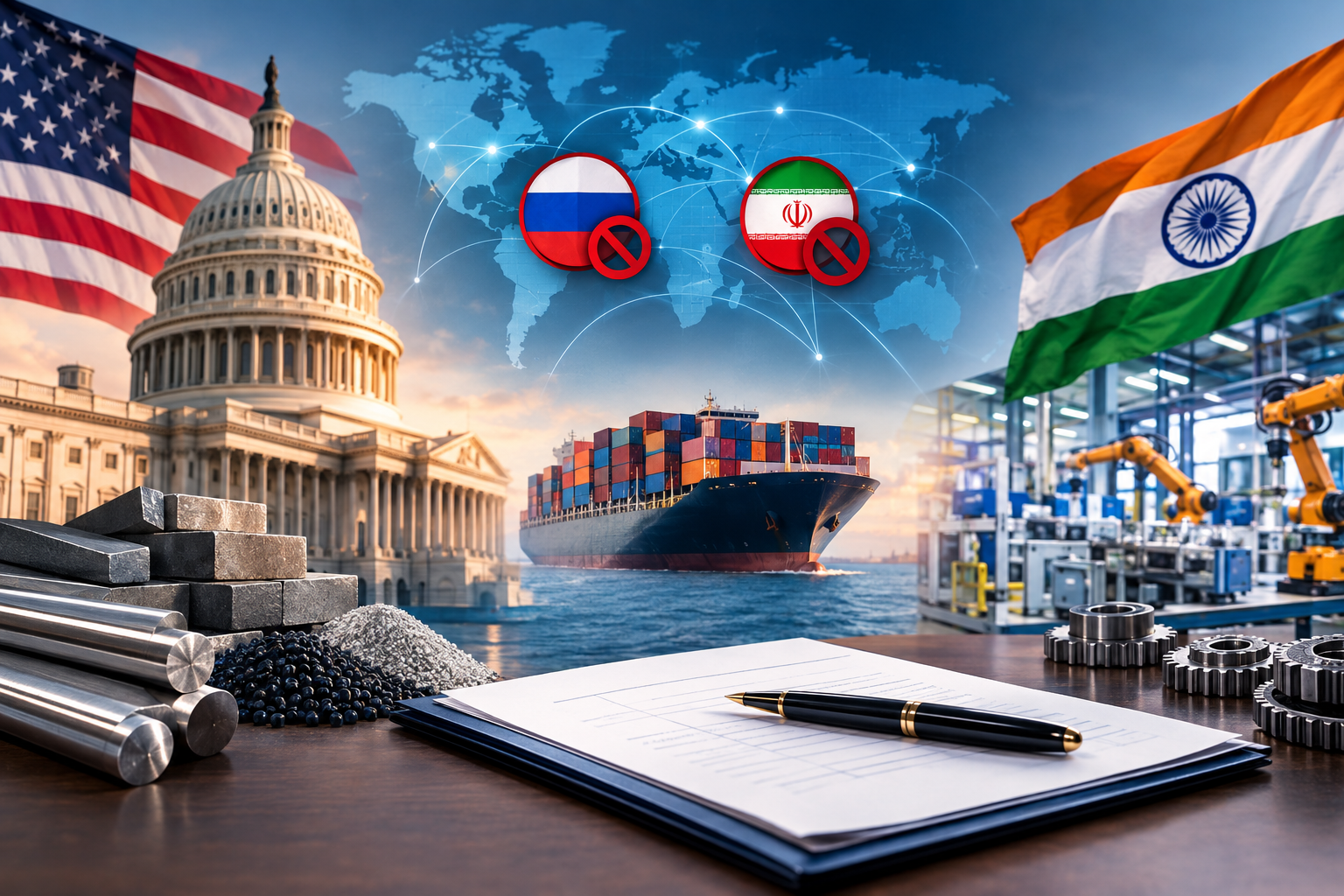
The global manufacturing sector is entering a demanding era where geopolitical legislation directly impacts factory operations. The introduction of H.R. 10076—the Lindsey O. Graham Sanctioning Russia and Iran Act of 2026—in the U.S. Congress signals a fundamental shift in international trade policy. For the Indian manufacturing sector, this legislation goes far beyond standard economic restrictions. It introduces an aggressive enforcement framework centered on extraterritorial secondary tracing.
H.R. 10076: Key Statutory Provisions
The Lindsey O. Graham Sanctioning Russia and Iran Act of 2026 (H.R. 10076) is a major bipartisan U.S. legislative initiative designed to empower US President to apply severe secondary economic pressure against Moscow and Tehran. Key legal provisions include:
- Section 102–104: Full asset freezing, property blocking, and correspondent banking prohibitions targeting Russian leadership, state-owned enterprises (SOEs), and major financial institutions.
- Section 105 & 110: Total bans on U.S. fund transfers involving Russian state actors and restrictions on international financial messaging systems (e.g., SWIFT) servicing sanctioned Russian banks.
- Section 106–109: Comprehensive bans on U.S. capital investments, sovereign debt purchases, and energy technology exports involving Russia.
- Section 113 (Secondary Tariffs on Third Countries including India): Directs the U.S. President to impose punitive tariffs (up to 100%) and trade restrictions on foreign countries or commercial entities that continue purchasing Russian crude oil, natural gas, or petroleum products, or that facilitate secondary sanctions evasion.
- Section 201: Extends the statutory enforcement authorities of the Iran Sanctions Act of 1996 through 2031, closing cross-border trade loopholes between Tehran, Moscow, and third countries.
Navigation in the Age of Hyper-Tracing: How U.S. Bill H.R. 10076 Redefines Strategy for Indian Manufacturing
The global manufacturing sector is entering a demanding era where geopolitical legislation directly impacts factory operations. The introduction of H.R. 10076—the Lindsey O. Graham Sanctioning Russia and Iran Act of 2026—in the U.S. Congress signals a fundamental shift in international trade policy.
For the Indian manufacturing sector, this legislation goes far beyond standard economic restrictions. It introduces an aggressive enforcement framework centered on extraterritorial secondary tracing. For manufacturing CEOs and policy leaders, managing this new landscape requires moving away from passive compliance toward active, long-term strategic realignment.
The New Reality: Multi-Tier Supply Chain Tracing
What sets H.R. 10076 apart is Section 113, which penalizes foreign entities and nations that purchase Russian energy or facilitate sanctions evasion. The central operational hurdle lies in American enforcement mechanisms, which trace material origins across multiple production stages and international borders.
Under these provisions, American buyers and customs authorities will examine not only direct imports from India, but the entire processing history of input components.
Consider a standard operational scenario:
- An Indian industrial manufacturer imports precision components, electronics, or chemical formulations from a supplier in Europe.
- If that European vendor utilized Russian-origin metals, raw minerals, or Russian gas in its manufacturing process, the downstream Indian finished good exported to the U.S. becomes subject to secondary trade penalties, audit delays, or outright rejection.
This multi-tier tracing mechanism effectively treats any Russian-origin material or energy input as a vulnerability across the entire global supply chain.
Economic & Operational Implications for India Inc.
The broader manufacturing ecosystem in India faces three primary operational pressures under this regulatory environment:
- Input Cost Volatility: Secondary tariffs targeting Eurasian energy exports threaten baseline industrial costs. Industrial heat, captive power generation, and petrochemical feedstocks face cost increases if Indian refiners scale back discounted hydrocarbon purchases.
- Administrative & Audit Overhead: Proving the non-Russian origin of every alloy, chemical input, and sub-component requires extensive documentation. Indian factories must build complete, audit-ready data trails for every export shipment bound for North America.
- Financial Clearing Constraints: With Section 110 targeting global financial messaging systems servicing sanctioned entities, Indian enterprises engaging in Eurasian trade face payment delays, elevated transaction fees, and stricter bank oversight.
Deepened Impact on Indian Manufacturing
The critical threat to Indian industry is multi-tier, cross-border origin tracing. U.S. authorities will scrutinize supply chains for any Russian-origin raw materials, energy inputs, or processing—regardless of whether goods enter India directly or route through third hubs such as the European Union.
- Direct Traceability Vector: Indian exporters utilizing Russian steel, aluminum, synthetic rubber, or basic chemical feedstocks risk trade penalties, rejection, or tariffs when exporting finished products to the U.S.
- Indirect / EU Third-Hub Vector: If an Indian factory imports precision sub-assemblies or specialized inputs from an EU supplier, and that EU supplier relied on Russian raw materials or energy, the downstream Indian finished product exported to the U.S. remains exposed under Section 113.
- Energy & Feedstock Cost Escalation: Compelling Indian refiners and power generation units to move away from discounted Russian hydrocarbons will raise baseline industrial power, process steam, and logistics costs across all manufacturing clusters.
- Compliance Overhead: Indian manufacturers will face heavy administrative burdens requiring batch-level Mill Test Certificates (MTCs), Bills of Materials (BOMs), and digital Certificates of Origin (COO) for every U.S.-bound export.
- The cost of energy and other supplies on which India/ other nations are relying on Russia and Iran will increase, even if India/ other nations find alternative sources.
- Other countries may also adopt similar measures under US pressure.
- India’s dependence on cheap Russia energy will go and so will be Indian manufacturing competitiveness will be adversely affected.
Strategic Framework for Indian Manufacturers & Government
To maintain global competitiveness and build genuine self-reliance, Indian industry and the Government of India must collaborate across short-, medium-, and long-term horizons.
1. Short-Term Action: Visibility & Segregation (0 – 12 Months)
- For Manufacturers: Perform rigorous supply chain audits across Tier-1 through Tier-N suppliers to identify any Russian-origin materials or energy inputs. Establish distinct manufacturing lines and accounting ledgers: one verified for North American exports, and another dedicated to domestic and non-restricted global markets.
- For Government: Establish a National Sanctions Compliance & Guidance Cell under EPCs of the Ministry of Commerce & Industry to assist mid-market exporters with regulatory navigation, risk assessments, and standardized digital country-of-origin documentation.
2. Medium-Term Action: Diversification & Digital Tracing (1 – 3 Years)
- For Manufacturers: Reduce reliance on any single export market by building trade relationships across ASEAN, Latin America, the Middle East, and Africa. Deploy digital ERP tracking systems to generate verifiable, tamper-proof origin data for all manufactured goods.
- For Government: Expand the scope of Production-Linked Incentive (PLI) schemes to include essential raw materials, specialized alloys, advanced polymers, and critical machinery, reducing domestic reliance on foreign supply chains.
3. Long-Term Action: Deepening Capabilities & Total Autonomy (3 – 5+ Years)
- For Manufacturers: Invest heavily in proprietary technology development, material science innovation, and captive renewable energy infrastructure. Shifting from contract manufacturing to owning core IP protects businesses from external trade shocks.
- For Government: Foster a resilient domestic industrial ecosystem capable of producing basic steel grades, advanced alloys, and capital equipment locally, while developing alternative international trade and clearing frameworks with emerging market partners.
Conclusion: Transforming Compliance into Competitive Advantage
U.S. Bill H.R. 10076 illustrates how geopolitical dynamics are reshaping global commerce through strict supply chain regulations and origin tracking. While this environment presents clear compliance hurdles, it also offers an opportunity to modernize operations.
By establishing complete supply chain transparency, expanding domestic production capabilities, diversifying global trade partnerships, and investing in internal innovation, Indian manufacturing can build long-term self-reliance and secure its role as a dependable global production hub.

ABOUT THE AUTHOR
Sanjay Chavre is Advisor to TAGMA India. A respected technocrat and policy strategist, Mr. Chavre has been a pivotal figure in the evolution of India’s manufacturing and tooling ecosystem. With decades of experience at the intersection of government and industry, he has contributed to the development of forward-looking policies that promote indigenous technology, strengthen domestic capabilities, and uplift MSMEs within the tooling and precision engineering sectors.
Mr. Chavre has held key roles in various government departments. He has been instrumental in formulating and executing initiatives that align with India’s long-term vision for industrial growth and self-reliance. His expertise lies in enabling public-private collaboration, fostering innovation ecosystems, and building frameworks that support sustainable industrial development.
In his current role as Advisor to TAGMA India, he continues to guide efforts aimed at enhancing the global competitiveness of Indian toolmakers. His insights have been vital in positioning the Indian tooling industry as a reliable and technologically advanced partner in the global supply chain.