

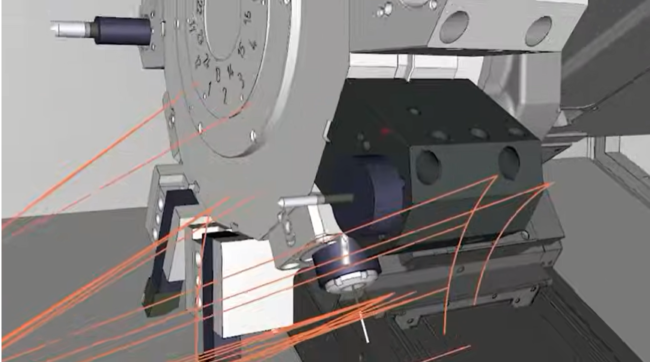
CIMCO has announced a significant upgrade to the turning and milling simulation capabilities in CIMCO Edit 2025 and CIMCO NC Machine Simulation. The latest enhancement streamlines the management and synchronization of tool mounts, improving overall workflow efficiency for CNC programmers.
With this update, tool locator mounts are now pre-defined within the machine definition, including precise positional data relative to key components such as the spindle and turret. As a result, CIMCO Edit can automatically position new tools on the correct mounts according to the machine configuration, reducing setup time and minimizing the risk of errors.
With this update, one can now view and modify these automatically assigned tool positions directly in the Tool Manager. This gives the operator a full control to configure or adjust mounts without editing the machine definition itself — for example, when adding new tool mounts or adjusting tool protrusion within a mount.
If the operator later make changes in the machine definition — for example, by adjusting a turret or mount position — all tools that are automatically positioned will update accordingly. However, if the operator have manually fine-tuned the position of a specific tool, that adjustment will be preserved and will not be overwritten.
When adding a new tool in the Tool Manager, the operator will find an option called “Add Advanced Tool Location”. This lets the operator specify exactly where the tool sits on the mount. If the operator skip this step, CIMCO Edit will automatically place the tool based on your machine configuration. The operator can always open the Tool Manager later to fine-tune the position if needed.
The operator can also manually select a different mount STL file, providing full flexibility for special configurations or complex setups. This ensures that even non-standard machines and tooling arrangements can be simulated correctly.
This update makes turning machine simulation fully reliable — working automatically in all standard cases, while still giving users complete control when needed.