

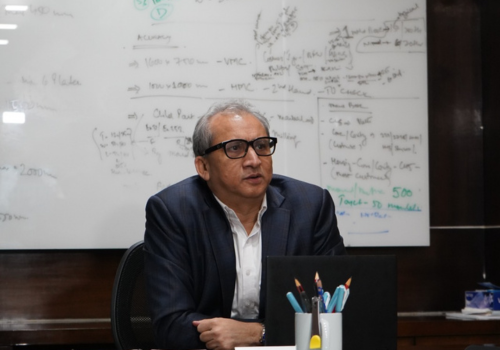
“Participation in past DMI exhibitions has opened new channels for the domestic die and mould industry by showcasing a wide range of technologies, manufacturing processes, and advanced equipment. These exhibitions serve as an excellent platform for industry stakeholders to interact, exchange knowledge, and explore new technological solutions,” says Sandeep Jain, Managing Director, Sandeep Edgetech Limited., in an interview for DMI 2026 exhibition.
What key trends, challenges, or growth opportunities do you see in the Indian Die and Mould Industry today, and how might they evolve by 2026?
The Indian die and mould industry is currently at a significant turning point, driven by a combination of domestic and global factors. On the domestic front, initiatives such as the Government of India’s Make in India program have encouraged manufacturing growth and strengthened local supply chains. India’s tooling industry is currently estimated at around ₹20,000–23,000 crore, with nearly 30–35% of the country’s tooling demand still met through imports, which presents a strong opportunity for domestic manufacturers to expand their capabilities.
Internationally, geopolitical shifts and the global China+1 strategy are prompting companies to diversify their manufacturing bases. As one of the world’s largest free markets with strong domestic demand, India is well positioned to benefit from these changes. With India’s manufacturing sector expected to reach $1 trillion by 2025–26, the demand for dies and moulds across sectors such as automotive, electronics, consumer goods, and engineering will continue to grow significantly. As a result, the Indian die and mould industry has substantial growth potential and strong opportunities in the coming years.
Which sectors (e.g., Automotive, EVs, Aerospace, Medical, Defence etc.) are driving demand for Dies and Moulds, and what opportunities do they present for the industry?
Several sectors are currently driving demand for dies and moulds in India. Historically, the automotive industry has been the largest consumer of tooling solutions. However, in recent years, the industry has diversified as other sectors have started contributing significantly. Industries such as white goods, consumer electronics, complex engineering components, defence and aerospace, medical devices, and electric vehicles are witnessing strong growth and increasing demand for advanced tooling solutions.
The opening of India’s aerospace and defence sectors to global participation has further attracted international companies. This is creating a stronger industrial ecosystem through technology transfer, investment, and innovation in the Indian manufacturing landscape.
How is India’s manufacturing push (e.g., Make in India, China+1) impacting the Die and Mould sector overall?
The current initiatives of the Government of India, particularly the Make in India program, along with the global shift toward the China+1 strategy, have created a highly positive environment for the Indian manufacturing sector. India is emerging as one of the few countries, apart from China, with the infrastructure, technical capabilities, and skilled workforce required to serve both global markets and growing domestic demand. The strong domestic market further strengthens this advantage, acting as a major catalyst for industrial growth.
Since nearly every manufacturing sector requires dies and moulds at some stage of its production cycle, the expansion of manufacturing activity directly benefits the die and mould industry. In addition, modern production systems and Just-in-Time (JIT) supply practices adopted by customers are increasing the need for reliable and locally available tooling solutions, giving a strong boost to the domestic die and mould sector. These developments have created significant opportunities for the Indian die and mould industry to collaborate with international partners. Such partnerships facilitate technology transfer, enhance manufacturing capabilities, and open doors to international markets.
What innovations or technologies (e.g., additive manufacturing, automation, AI, simulations) are shaping the competitiveness of the die and mould industry?
The Indian die and mould industry has successfully adopted and integrated advanced technologies available across the world to become more competitive and improve its quality standards. Over the years, the industry has significantly upgraded its infrastructure and technological capabilities.
Today, modern tooling facilities in India are equipped with advanced simulation software, digital tool design systems, automation technologies, and AI-assisted manufacturing. These technological advancements have enabled the domestic industry to significantly improve design accuracy, production efficiency, and overall product quality.
In addition, the use of high-performance tool steels and other advanced materials has further enhanced the durability and performance of dies and moulds, ensuring higher precision and reliability in manufacturing operations.
What role do initiatives like precision manufacturing and talent development play in expanding the Die and Mould industry into new markets?
Precision manufacturing and talent development play a crucial role in the growth and expansion of the die and mould industry. High levels of precision in manufacturing help improve tool life and reduce overall production costs, enabling manufacturers to remain competitive while maintaining high quality standards for OEMs and end customers.
The industry is heavily dependent on skilled professionals, as modern tooling facilities are equipped with highly advanced machines capable of delivering superior accuracy and quality. However, the full potential of these technologies can only be realized through a highly skilled and well-trained workforce. Continuous investment in skill development, technical training, and knowledge enhancement is therefore essential for the sustainability and global competitiveness of the Indian die and mould industry.
How has participating in past DMI exhibitions contributed to growth, networking, or collaborations within the tooling ecosystem?
Participation in past DMI exhibitions has opened new channels for the domestic die and mould industry by showcasing a wide range of technologies, manufacturing processes, and advanced equipment. These exhibitions serve as an excellent platform for industry stakeholders to interact, exchange knowledge, and explore new technological solutions. Such events also provide an opportunity to understand the manufacturing capacity and capabilities of different players in the industry. This interaction helps create strong synergies and encourages collaboration between toolmakers, technology providers, and end users. These exhibitions also help the industry benchmark itself against global standards.
What makes DMI 2026 a valuable platform for the Die and Mould industry to showcase its strengths to domestic or global customers?
DMI 2026 will serve as an important platform for the die and mould industry to showcase its capacity and capabilities while interacting with a wide range of stakeholders at a single location. Such exhibitions provide an excellent opportunity for industry participants to present their strengths, explore new business opportunities, and expand their market reach. The event also allows companies to gain valuable insights into the latest technologies, processes, and industry trends. Gathering such insights individually by meeting stakeholders separately would be both difficult and time-consuming. With manufacturers, technology providers, equipment suppliers, and end users present under one roof, the exhibition facilitates efficient networking and meaningful collaborations.
What products, technologies, or launches are you planning to showcase at DMI 2026, and why are they significant for the industry? (Please share the description of the product and share product image in the link below.)
At DMI 2026, we plan to showcase a range of advanced tool steels and mould steels designed for high-precision tooling applications. We will also highlight the growing adoption of 5-axis VMC machining, which enables toolmakers to produce complex mould geometries with greater accuracy and efficiency. Along with this, we will present some of the newest NACHI material grades that we maintain in stock, ensuring faster availability for customers. Through our wide range of materials and value-added services, our objective is to position ourselves as a one-stop solution provider for the mould and tooling industry.