
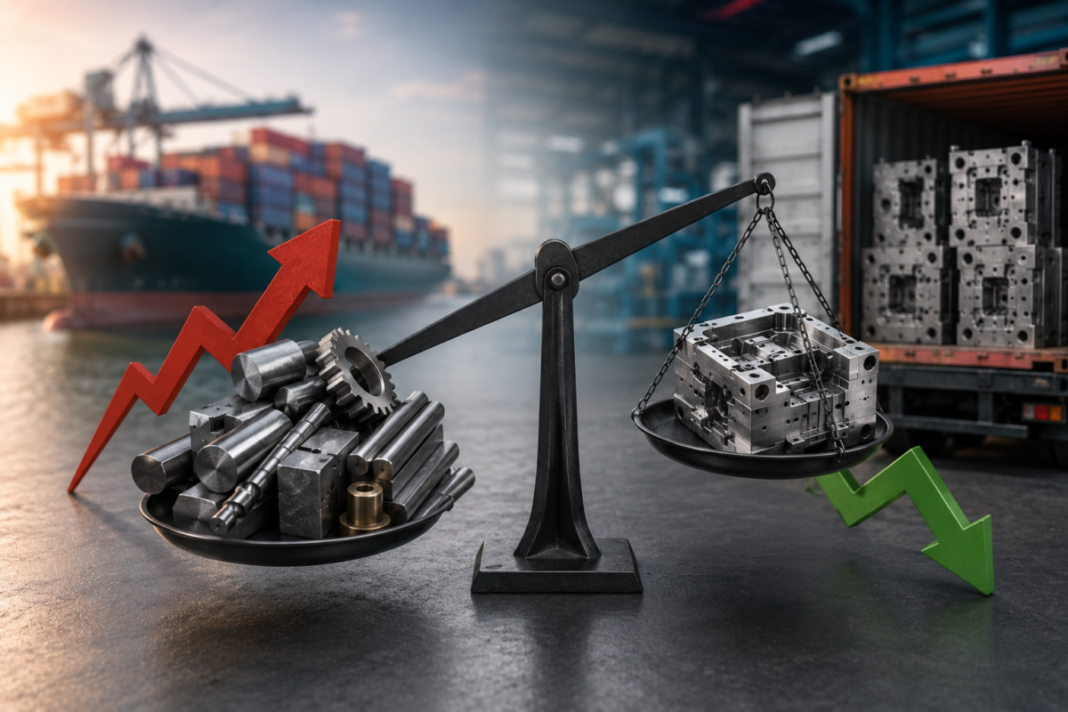

In a classic case for India’s tooling sector, higher import duties on raw materials and components compared with finished tools are steadily eroding the competitiveness of domestic toolmakers. Industry leaders warn that the imbalance is making imported tools more economical than local manufacturing, despite India’s growing tooling capabilities.
Input Costs vs Imported Tools
The duty gap has become a sore point for toolmakers across the country. Many say the higher levies on inputs compared with finished tools are hurting their margins and making imports the easier option.
Sachin Netrabyle, Business Head, Magna Plastic Corporation, said, “Generally, the major imports for toolmakers are tool steel and hot runners, which attract around 7.5% duty. In most cases, these are brought in by dealers or subsidiaries of global companies, so tool manufacturers themselves rarely pay directly. However, when we import machines, sensors, or other components required for moulds, the duty is consistently 7.5%.”
Echoing the same strain on competitiveness, Arvind Chawla, Director, MEPL SIDDHOHUM Pvt Ltd, said, “The cost of steel and hardware is a major factor in tool manufacturing. Duties on imported steel are high, which makes steel costlier in India. But when finished parts made from that steel are imported, the duty is lower. This creates a situation where importing parts directly reduces tool costs, while local toolmakers face higher input costs.
As of the 2026 budget announcements, the 7.5% Basic Customs Duty (BCD) on machines, sensors, and components often used in toolmaking and molding remains a significant cost factor for Indian toolmakers, particularly when high-precision components cannot be sourced domestically. This duty, along with the 18% Integrated GST (IGST) and a 10% Social Welfare Surcharge (SWS) on the BCD, can increase the net import cost by approximately 22% or more, putting pressure on operating margins, especially for small and medium-sized toolmakers.
Speaking about the duty burden affecting competiveness, Mr. Netrabyle expressed, that, “Even though 7.5% may sound small, it adds up significantly, especially for smaller toolmakers. If reduced, it would help the industry a lot. Free Trade Agreements (FTAs) with countries like Japan, Singapore, and Malaysia have eased imports of machines and cutting tools, but agreements with countries that don’t contribute to manufacturing like New Zealand don’t benefit us.”
“For example, Japanese suppliers provide stability because their currency is steady compared to USD, and their carbide cutters haven’t seen the 300% price hike that imports from China, Taiwan, or Korea have. So while FTAs with Japan help, the broader issue remains: import duties on raw materials and components are higher than on finished tools. This imbalance makes imported tools cheaper and impacts the cost competitiveness of Indian tool rooms.” Mr. Netrabyle further concluded.
Impact of Inverted Duty Structure
Concerns raised by toolmakers also reflect a broader issue highlighted by industry bodies and trade associations.
“Inverted customs duty structure on finished goods is eroding competitiveness of the manufacturing sector and discouraging domestic value addition, as the same tariff on the raw material or intermediate product is lower,” the Federation of Indian Chambers of Commerce and Industry (FICCI) said in a statement, which was published in Business Standard news report.
An inverted duty structure happens when the import duty on raw materials and components is higher than the duty on finished products. This creates a problem for domestic manufacturers because making products locally becomes more expensive than importing ready-made goods. As a result, imports increase, while local manufacturing, value addition, and employment opportunities are affected, going against the goal of promoting ‘Make in India’.
The FICCI statement further stated that, the inversion is not because of basic custom duty but in some cases as a result of additional duties. In many cases, differential in the CVDs (countervailing duty) of final products and raw material showed a similar problem in excise regime too. With India having a slew of regional or bilateral free trade agreements and negotiating more, the duty inversion is affecting the key sectors.
Now, this means that India’s current duty system is making manufacturing less competitive because companies often pay higher duties on raw materials and components than on finished imported products.
Mr. Chawla, said, “Tool costs depend on several elements like raw material, hot runner systems, controllers, hardware, and the machines used to make tools. If the duty on finished tools is kept low while components remain expensive, Indian toolmakers lose competitiveness.”
Giving a solution on what is required, Mr. Chawla, stated that, “What we need is a reversal, i.e., higher duty on imported tools and lower duty on components, so that manufacturing in India becomes viable.”
He further explains, that, “The same imbalance exists in machines. For example, if injection moulding machines made in China comes in at lower duty, the cost of making them in India is automatically higher. Logistics costs are minimal, so even a 10% difference in manufacturing cost abroad can easily undercut Indian production.”
Mr. Chawla suggests that India should impose anti-dumping duties on unfairly cheap imports. The idea is to create fair competition and support Indian toolmakers. He noted that, “In sectors like automotive, India has the capability to make moulds locally. But steel alone contributes 20–25% of mould cost, and if steel is 50% more expensive here, plus lower duties on imported moulds, foreign suppliers gain a direct advantage. To protect domestic toolmakers, anti-dumping duties should be applied. These are permitted under WTO rules when imports are priced below fair market value and cause material injury to local industry. Such measures would help level the playing field for Indian manufacturers.”
Measures Needed to Support Domestic Manufacturing
Industry experts believe that correcting the inverted duty structure requires a combination of policy reforms and manufacturing support measures. One of the key steps is to rationalise the tariff structure by keeping import duties on raw materials and intermediate components lower than those on finished goods, helping Indian manufacturers remain competitive. Experts also suggest calibrated tariff protection and production-linked incentives (PLI) to encourage local value addition and offset higher manufacturing costs. In addition, simplifying customs procedures and reducing delays in importing essential raw materials can improve operational efficiency for manufacturers. Regular reviews of tariff policies are also important to prevent duty imbalances caused by changing trade agreements and tax structures. Alongside this, promoting local sourcing, strengthening domestic supply chains, and investing in skill development and technology upgradation can help India build stronger manufacturing capabilities and reduce dependence on imports.
Supporting the broader industry demand for tariff correction, Dinesh Kumar Sharma, Former President, TAGMA, India, remarked, “India today possesses strong tooling capability, technical expertise, and manufacturing potential. However, unless the duty structure is aligned to support domestic value addition, Indian toolmakers will continue to face an uneven playing field against imported tools. Rationalisation of duties on raw materials, tooling components, and advanced manufacturing equipment is essential if we truly want to strengthen Make in India and build globally competitive tool rooms.”
Industry stakeholders believe that unless these structural duty imbalances are addressed, India’s tooling sector may continue to face pricing pressure from imports despite having strong manufacturing capabilities.