

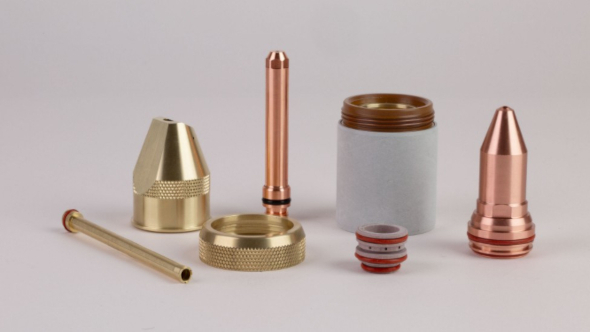
Hypertherm Associates, a U.S.-based manufacturer of industrial cutting systems and software, has launched its patented MAXPRO200 FlushCut consumables for thick-metal removal applications. The technology is designed for industries including shipbuilding, mining, structural steel, and heavy equipment fabrication.
MAXPRO200 FlushCut enables operators to remove attachments such as pad eyes, D-rings, lifting lugs, and alignment fixtures up to 90 percent faster than traditional oxyfuel methods, while reducing grinding by up to 40 percent without damaging the base material. The liquid-cooled consumables support cutting of mild steel up to 64 mm (2.5 inches) thick and offer extended consumable life.
“Early field trials of MAXPRO200 FlushCut consumables have generated strong enthusiasm,” said Andrew Mumford, Product Manager at Hypertherm Associates. “Customer after customer showed us real‑world applications where this technology can improve safety and dramatically reduce job time, often completing jobs in minutes that once took hours.”
Hypertherm´s MAXPRO200 plasma cutters support handheld torches, mechanized carriages and tractors, X‑Y cutting tables, and robotic cutting systems, delivering flexibility across a wide range of applications. The intuitive FlushCut drag‑cutting feature simplifies training and helps address skilled‑labor challenges while maintaining consistent, high‑quality results. The design also improves operator comfort, reduces noise, and lessens fume exposure compared to traditional cutting methods such as oxyfuel and carbon arc gouging.
With MAXPRO200 FlushCut consumables, Hypertherm Associates expands the company’s industry‑leading FlushCut portfolio across MAXPRO200 and Powermax® plasma cutters to provide operators with trusted performance for thin‑to‑thick materials in demanding fabrication environments.