

Almost everyone is aware of the electric vehicle (EV) revolution in the automotive industry. The switch from diesel and petrol engines to electric power is constantly in the news, and despite some obstacles to widespread adoption, the clock is ticking to a total switch by 2035. Here Gareth Tomkinson, Business Development Manager in Renishaw’s CMM & Gauging Products Division, explores the role of metrology in solving these challenges.
The global importance of reducing our reliance on fossil fuels has set the scene for the replacement of combustion engines with e-transportation. However, a snapshot of sales in 2023, showed EVs made up only 16 per cent of new car registrations in the UK, according to Zapmap. While they may be an increasingly common sight on the country’s roads, widespread adoption by the majority has yet to come.
Driving change
Whilst early EV adopters enjoy the benefits of a more peaceful, carbon friendly motoring experience, they are also learning to live with new issues like higher purchase prices, low battery range and lack of charging infrastructure. Across the world, governments, local authorities, large employers and manufacturers all have a part to play in providing improvements that encourage EV adoption as part of the overall drive to net zero.
Changing lane
Further upstream, manufacturers have switched some of their traditional powertrain lines, by removing the equipment used to machine cylinder heads, cylinder blocks, cranks etc. and replacing this with new processes for components like rotors and stators for electric motors. Although the electric motor is far from a new technology, the high efficiency versions required on such a mass scale do bring new engineering challenges. At this early stage in the evolutionary cycle of the ‘new’ electric motor, we see engineers applying their talents and producing a constant stream of incremental design improvements. However, each of these new designs must go from the CAD (Computer Aided Design) screen through a manufacturing process and end up as a finished product with the precise tolerances attributed to each part. This makes quality checks essential to ensuring efficiency, reliability and safety, especially important with new and relatively unproven designs.
These inspection checks are used by manufacturers in two distinct ways: Firstly, as a standard pass or fail quality check for individual components. Secondly, as a source of data that can be used to make constant micro-adjustments to upstream machining. Much like the small steering wheel adjustments we make to keep a car in between the white lines on a highway, these ‘process control’ adjustments help to nudge machining operations towards the ideal size and prevent drift towards out of tolerance limits.
Two-way traffic
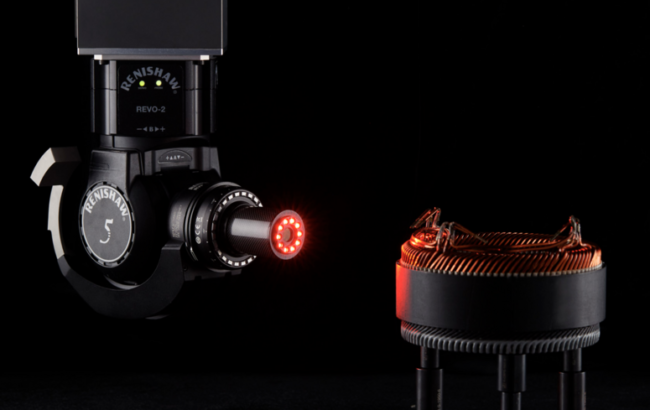
Providing inspection solutions that cater to the changing needs of the automotive industry requires a two-way conversation. It’s almost impossible for manufacturers to predict exactly what new designs will arrive on their inspection table in the future. However, a flexible measurement system, such as Renishaw’s REVO® five-axis measurement head, is now available with a wide range of different sensors that can be tailored to future demands. These include rapid tactile scanning probes, non-contact camera-based sensors, a surface finish sensor and an ultrasonic thickness probe. Renishaw has worked closely with our customers to understand their unique requirements and match these to the systems we provide.
Down the road
As the manufacturing industries we serve evolve, so must we. As companies race to find better EV designs, inspection must not only be rapid and reliable, but flexible too. Improving the driving range of EVs means manufacturers must produce a range of prototypes with new components, experimenting with different materials and designs. Providing flexibility in the manufacturing inspection setup is increasingly important to help lines that are retooled or upgraded.
Flexibility is also important because even though the future currently looks likely to be heavily dominated by electric vehicles, manufacturers will offer a diverse range of propulsion technologies for the various niches of sustainable transport. Much like today’s mix of vehicles using petrol, diesel and LPG, each suitable to different applications, vehicles powered by eFuels, hydrogen and batteries might all have a place tomorrow.
When working on burgeoning technologies such as electric vehicles, it can be difficult to foresee revolutionary step-changes before they appear. Future predictions are also notoriously tricky to get right. By prioritising early discussions with customers, providers of metrology equipment can develop innovative and agile inspection solutions. Renishaw is providing inherently flexible technologies to meet its customers’ demands, helping to create more efficient, reliable and affordable EVs for a more sustainable future.
For further information on what Renishaw is doing for the automotive industry, visit www.renishaw.com