
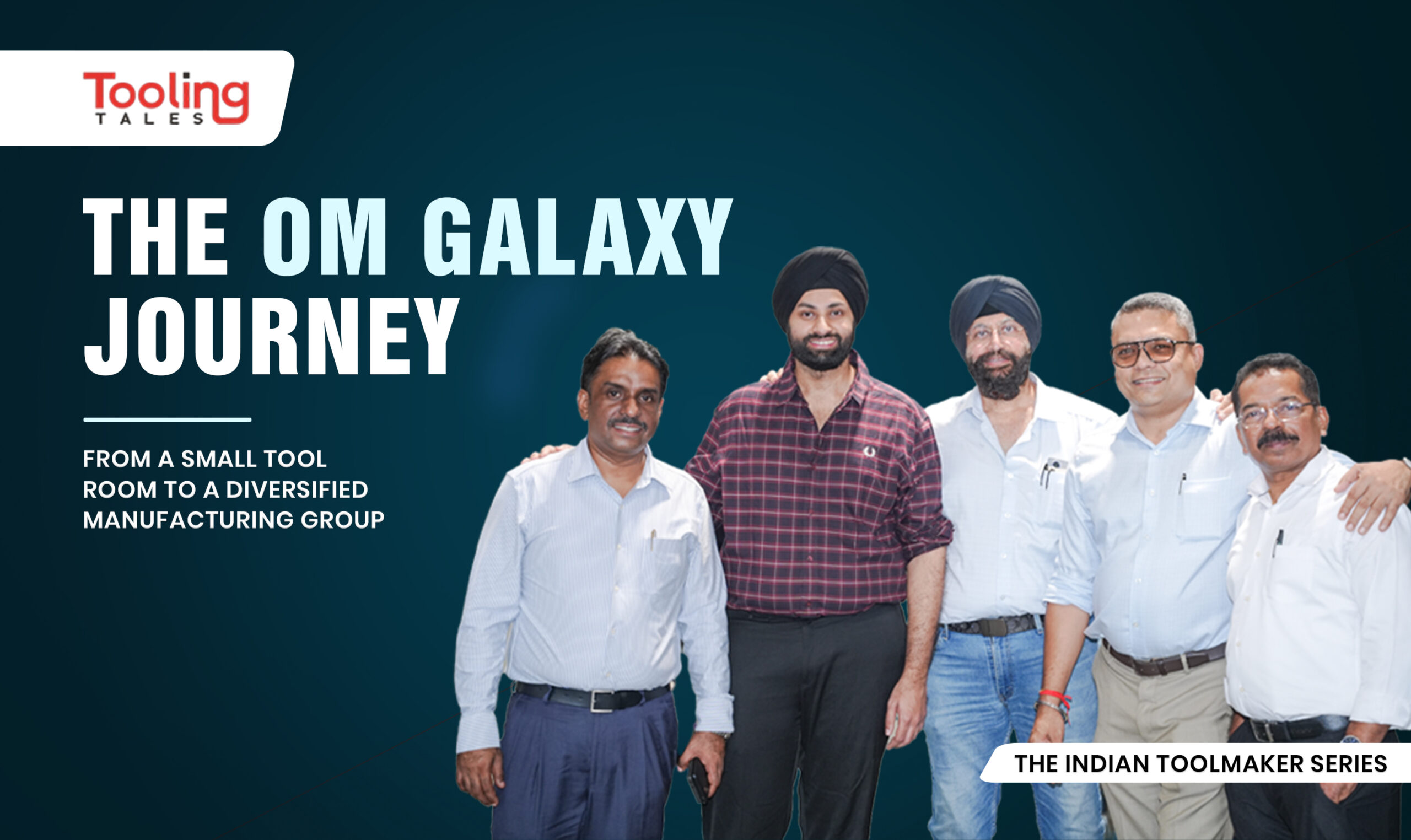
In manufacturing, transformation rarely happens overnight. It is a very slow and tedious process built over decades, through decisions that may have seemed small at the time but eventually shape the direction of an entire organisation.
For Om Galaxy Limited, that journey began in 1980 with Beacon Dies, founded by Late Shri Batchittar Singh Baddhan at a time when India’s tooling industry was still in its infancy. Four decades later, now the company has grown from a conventional tool room into a diversified manufacturing group spanning precision mould-making, automotive manufacturing and consumer products, with a new greenfield facility at Poman set to mark its next phase of growth.
“His vision was simple but ambitious, to build a company grounded in craftsmanship, precision, and trust,” says Opinder Singh, Founder & Managing Director, recalling his father’s founding philosophy. At the heart of Om Galaxy’s journey has been a belief that has held steady across every expansion: better capabilities create better opportunities.
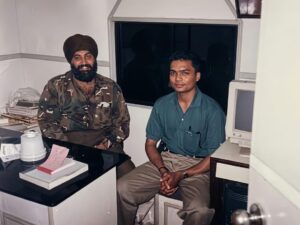
A Turning Point with the FIRST CNC in 1996
When Opinder Singh joined the family business in 1986, manufacturing was still heavily dependent on individual craftsmanship. Skilled die makers worked with traditional methods, and the pace of production often hinged on the expertise and availability of a small number of craftsmen.
The opportunity, therefore, was not to replace craftsmanship, but to build upon it. As CNC machining began gaining traction in India, Om Galaxy saw technology as a way to bring better precision, consistency and efficiency into its processes. The company installed its first CNC machine in 1996, an early and bold move for an Indian mould-maker at the time.
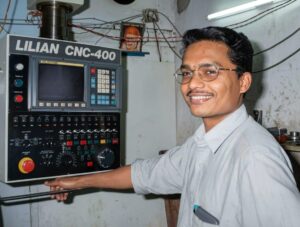
“That decision was a turning point that helped lay the foundation for our evolution into a technology-driven manufacturing company,” Mr Singh reflects.
The momentum continued into the following decade. By 2004, the company was investing in larger machines and adopting 5-axis machining, driven by growing demand for larger, more complex tooling. Rather than compete purely on volume, Om Galaxy chose to build capabilities that would let it take on increasingly sophisticated projects.
“Our philosophy has always been simple: if you want better work, you need better machines,” says Mr Singh.
In 2008, the business was rebranded as Om Galaxy Limited, a name that reflected the coming together of founding partners Jyothish Nambiar and Sathyapalan A. Poyil (previously associated with Galaxy Tools) with the original Beacon Dies legacy, blending technical capability with shared ambition for the next phase of growth.
From Vendor to Engineering Partner
The tooling industry has changed significantly since those early years. Customers today look beyond a company that can simply manufacture a mould to a drawing, they expect tooling partners to contribute to design, manufacturability, problem-solving and production efficiency.
Om Galaxy has responded by placing engineering at the centre of its approach and engineering. Its leadership team, including engineers Jyothish Nambiar and Sathyapalan A. Poyil, brings the technical depth needed to engage customers on complex requirements from the concept stage.
“The mindset must shift from executing orders to solving problems,”Mr Singh explains.” Engineers need to understand the customer’s end product, manufacturing processes, and business objectives. Becoming an engineering partner is not a one-time achievement, it is an ongoing commitment.”
Reinvestment as a Long-Term Philosophy
One of the defining characteristics of Om Galaxy’s journey has been its willingness to keep investing even when circumstances have been uncertain. A notable example came in October 2020, during the COVID-19 pandemic, when the company invested in the FM 350 machine, strengthening its capabilities in preparation for a recovery it believed would come, even as many businesses pulled back on capital expenditure.
“Times of uncertainty often create opportunities for companies willing to think long term,” says Mr Singh.” Looking back, it reinforced our belief that sustainable growth comes from continuing to invest in the future, even during challenging times.”
That belief has hardened into an organisational principle. “If you stop investing, you stop progressing,” Mr Singh says simply. In an industry where technologies, customer expectations and processes are constantly evolving, reinvestment is treated not as an expansion strategy but as the foundation of long-term competitiveness.
Expanding the Manufacturing Footprint
Om Galaxy’s evolution has also meant moving well beyond traditional mould-making. In 2019, the company introduced OMG Auto and entered the automotive ecosystem, combining decades of tooling and precision-engineering experience with automotive industry expertise brought in through its association with Mr Nandkumar Puthiyaveetil. The sector represented a natural extension of the company’s capabilities, particularly as India’s automotive industry demanded ever-higher levels of precision, quality and reliability.
Then, in 2025, came a bigger leap into the consumer-facing space with WONDRA. For a company with deep roots in industrial manufacturing, the move meant applying decades of engineering and product-development expertise to products that interact directly with consumers.
“Many of the fundamentals carry over: quality, consistency, innovation, and customer focus are just as important in consumer products as they are in industrial manufacturing,” Mr Singh notes. “What we had to learn was the consumer side of the equation: understanding customer behaviour, branding, marketing, and product experience.”
Together, these moves point to a larger ambition: building a diversified manufacturing group while retaining engineering excellence as its common foundation.
Poman: Building for the Next Chapter
That ambition is now taking physical shape at Poman. The group’s new 184,000 sq. ft. greenfield facility is among the most significant investments in Om Galaxy’s history, a state-of-the-art green manufacturing facility designed to expand the group’s capabilities and provide the infrastructure needed for larger, more complex projects. It is expected to nearly triple manufacturing capacity while improving operational efficiency and scalability for future growth.
Sustainability has been built into the factory’s design rather than treated as a separate initiative. “Manufacturing companies have a direct impact on resources and the environment, so sustainability must be embedded into operations from the beginning,” Mr Singh says. “We believe responsible manufacturing and business success should go hand in hand.”
Staying Rooted While Continuing to Reinvent
Looking back, the Om Galaxy story is one of continuous reinvention from Beacon Dies in 1980, through CNC and 5-axis machining, the formation of Om Galaxy Limited, the move into automotive, the launch of WONDRA, and now Poman.
“What makes me most proud is that we have remained true to our values while continuously evolving,” says Mr Singh. “We have championed the spirit of ‘Made in India’ by creating world-class manufacturing capabilities, investing in local talent, and demonstrating that Indian companies can compete at the highest global standards.”
His advice to the next generation of Indian manufacturers is characteristically direct: “Never stop learning and never stop investing in improvement. Companies that embrace change while staying committed to quality and integrity will always find opportunities to grow.”
For a company that began as a small tool room in 1980, that philosophy has already carried it a long way. With Poman on the horizon, the next chapter of the Om Galaxy story looks set to be its most ambitious yet.