

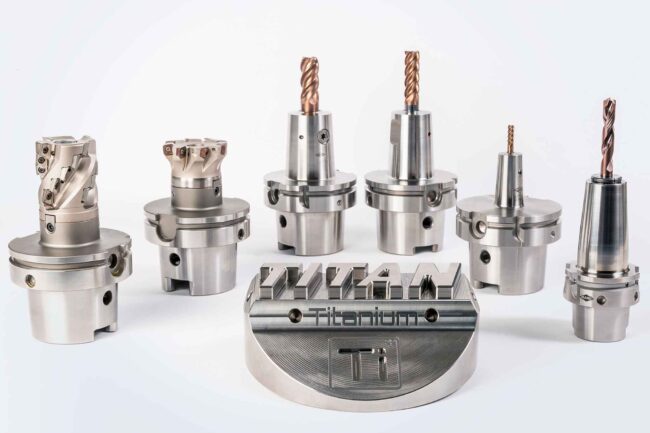
Holistic process understanding for optimum machining results
Machining titanium is fundamentally different from machining cast iron or steel. For economic results, tool technology and the process must be optimally designed. With its holistic understanding of the overall correlations when machining titanium, MAPAL is able to identify the optimum combination of precision and cost-effectiveness.
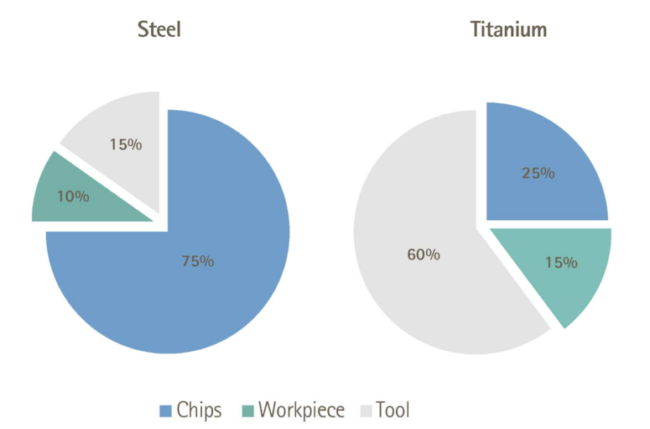
The material properties of titanium are valued in many fields such as aerospace, the automotive industry and medical technology. However, the material is notoriously difficult to machine. This is because of its extremely low thermal conductivity. By way of comparison, with steel machining, ten percent of the temperature remains in the workpiece, 15 percent causes stress on the cutting tool and by far the largest proportion, 75 percent of the heat, is transferred into the chips and removed with them. Titanium is completely different. In this case, the chips only absorb 25 percent of the heat. The lion’s share of 60 percent goes into the tool and causes a high thermal load on the cutting edge or the cutting material. This leads to considerably shorter tool lives. In this way, the cutting material costs become the focus of attention.
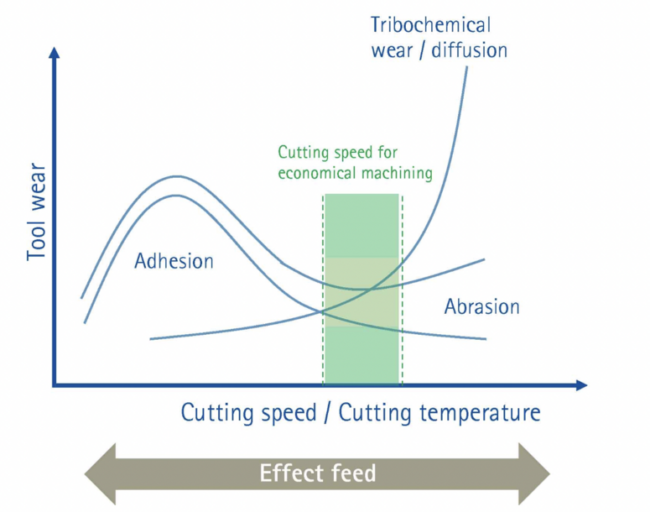
Influence of the cutting speed on wear and tear
If the cutting speed is too low, this can lead to adhesion, i.e. the material sticking. If the cutting speed is too high, the risk of abrasion and tribochemical wear increase sharply and the cutting material is burnt. One way to ascertain the condition of the cutting edge is to look at the width of the wear mark. In a stationary range, it grows slowly and continuously. If this range is exceeded and the machining enters the transient range, a rapid and incalculable failure of the tool cutting edge occurs. This happens when the selected cutting speed or feed is too high. There is a difference of up to 100 percent in tool life between the stationary and the transient range.
It is very important for MAPAL’s area field service to help run in processes, to check the width of the wear mark and to show the customer when the end of the stationary range has been reached, for reliable and optimum machine running times. As a general rule, MAPAL recommends replacing the tool when wear is approximately 0.2 mm. A carbide milling cutter can still be reground then, but not at higher levels of wear.
MAPAL has incorporated process knowledge of titanium machining into the development of its tool technology. The focus is on wear and tear criteria and their influence even beyond the most suitable cutting material. To ensure optimum heat resistance, MAPAL uses innovative cutting materials, i.e. selected carbide grades and matching coatings that produce as little friction as possible. The micro and macrogeometry with extremely positive tool geometries, polished rake faces and measures for efficient cooling pave the way for cost-efficient machining. However, careful balancing of the cutting data is essential for the cost of titanium machining.
Faster doesn’t mean lower costs per part
When machining steel and cast iron, higher cutting speeds often mean higher productivity and lower overall costs, which are made up of machine costs and cutting material costs. The machine costs get lower the quicker and more efficiently the machine operates. Although the cutting material costs increase in this case, an optimum in terms of overall costs is nevertheless achieved at a relatively high cutting speed. Conversely, when it comes to titanium, higher cutting speeds are not expedient. Tobias Gräupel, Technical Expert Indexable Tools at MAPAL, proves this with an economic efficiency calculation that optimises the cutting data of titanium machining from a cost point of view. A milling operation with a NeoMill-Titan-2-Corner with four cutting edges that machines TiAl6V4 with a cutting depth of 4 mm and a cutting width of 24 mm is considered. An examination of different combinations of feed rates and cutting speeds leads to a clear recommendation in terms of the machining values for titanium machining.
By way of comparison, when machining a steel part, doubling the cutting speed from 200 m/min to 400 m/min resulted in an overall cost saving of 24 percent per part. When machining a titanium workpiece, increasing the cutting speed from 32 m/min to 50 m/min results in a cost increase of 259 percent. “An increase in the cutting speed is clearly reflected in the overall costs. They skyrocket”, comments Gräupel. The optimum cost is achieved with a machining operation with high feed rates and low cutting speeds. If, on the other hand, the cutting speeds were maximised in addition to the high feed rates, the costs would be more than four times as high.
“These economic efficiency calculations are vital especially for larger lot sizes”, highlights Gräupel. After all, when producing large quantities, the overall costs play a major role when it comes to making investment decisions. Inefficient cutting parameters cause the total costs in titanium to shoot up; only the combination of innovative tool technology and optimum process design leads to a perfect result. The technical consultants at MAPAL harness this expertise to help production managers achieve optimum results regardless of machining and production batch sizes.