

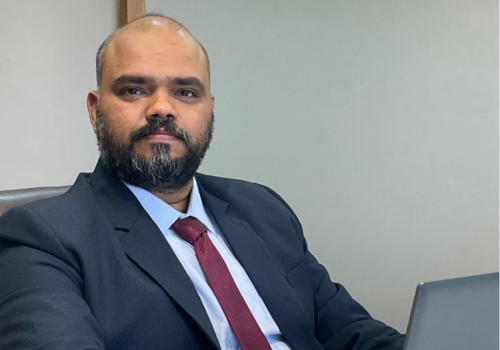
“By 2026, Indian makers will evolve from import substitution to export competitiveness, fueled by EV, electronics, aerospace, and defence growth, driving demand for high-speed, multi-axis, reliable machine tools”, says Vimlesh Tiwari, AGM – National Sales, Hurco India Pvt., Ltd.
What key trends, challenges, or growth opportunities do you see in the Indian die and mould industry today, and how might they evolve by 2026?
The key trends shaping the Indian die and mould industry today include a shift toward EVs, electronics, and lightweight parts, along with growing adoption of 3+2 and 5‑axis machining. Challenges remain, such as skilled manpower shortages, cost and delivery pressures from OEMs, high investment barriers for advanced machines, and the need to reduce polishing, rework, and lead time.
On the opportunity side, strong demand from EV, aerospace, and defence tooling is driving growth, supported by rising exports to Europe and North America. By 2026, 5‑axis machining will move from premium to mainstream, automation will become standard in serious tool rooms, Indian tool rooms will establish themselves as global suppliers, and buyers will prefer complete solutions over standalone machines marking a more technology‑driven, globally competitive future.
Which sectors are driving demand for Dies and Moulds, and what opportunities do they present for the industry?
Automotive (ICE + EV) is the largest demand driver for dies and moulds, driven by high volumes of injection moulds and die-casting dies, creating opportunities for repeat orders, automation, and cycle-time reduction. EVs are the fastest-growing segment, requiring new moulds for battery housings, connectors, and lightweight components, with strong demand for complex geometries and 3+2 and 5-axis machining.
Aerospace adds low-volume but high-value tooling needs, involving tight tolerances and exotic materials, supporting demand for high-accuracy 5-axis machining and premium machines. Defence is growing under the Make in India initiative, with demand for special dies, fixtures, and low-volume tooling, offering long-term and stable programs. Medical devices rely on high-precision plastic moulds where surface quality and repeatability are critical, creating opportunities for high-speed machining and fine finishes. Consumer and electronics sectors, with short product life cycles and frequent mould changes, drive demand for fast turnaround and flexible machining.
How is India’s manufacturing push (e.g., Make in India, China+1) impacting the die and mould sector overall?
Make in India and China+1 are transforming Indian die and mould shops into global suppliers, boosting demand for advanced, productivity-focused machining. This accelerates tooling localisation as OEMs shift sourcing from imports to cut costs, lead times, and risks, while China+1 draws global orders via multinational bases needing high-precision dies and moulds. Higher quality standards from global OEMs push investments in advanced CNC, 5-axis, and automation, with shorter delivery timelines prioritising speed and accuracy over price.
By 2026, Indian makers will evolve from import substitution to export competitiveness, fueled by EV, electronics, aerospace, and defence growth, driving demand for high-speed, multi-axis, reliable machine tools.
What innovations or technologies (e.g., additive manufacturing, AI, simulations) are shaping the competitiveness of the die and mould industry?
Tool rooms adopting 5-axis machining, simulation, AI-enabled CAM, and hybrid additive processes excel in speed, accuracy, and cost. High-speed & 5-axis enable complex cavities, superior surface finish, and shorter lead times, while simulation & digital twins like mould-flow and machining simulation reduce rework, trials, and risks. AI-driven CAM optimizes toolpaths, parameters, and cycles for efficiency.
Hybrid additive manufacturing supports conformal cooling, inserts, and prototyping to cut cycle times & boost mould life. Automation & in-process probing enable lights-out operation, consistent accuracy, and less skill dependence. IoT & machine monitoring track spindle load, uptime, and tool life for higher OEE. Together, these innovations align speed, precision, and reliability with global standards.
What role do initiatives like precision manufacturing and talent development play in expanding the die and mould industry into new markets?
Precision manufacturing and skilled talent are key to elevating Indian die and mould makers from domestic jobs to global, high-value markets. Precision enables global-quality tooling with tight tolerances, minimising polishing, rework, and lead times to build confidence with export customers and OEMs in aerospace, medical, and defence. Talent development unlocks 5-axis & high-speed machining potential through skilled programmers and operators, enhancing CAM & process knowledge for higher productivity, consistency, and less trial-and-error.
How has participating in past DMI exhibitions contributed to growth, networking, or collaborations within the tooling ecosystem?
DMI acts as a catalyst, converting visibility into business, contacts into collaborations, and technology into competitiveness. Its exhibitions drive growth through direct access to OEMs, Tier-1 suppliers, and global buyers, generating new enquiries and repeat business. They foster networking among tool rooms, machine builders, CAM providers, and material suppliers to build a complete ecosystem. Technology exposure enables benchmarking against latest machining, automation, and digital trends. Collaborations emerge via joint development, subcontracting, and export alliances. Overall, DMI transforms participation into tangible growth, networks, and competitiveness for the die and mould industry.
What makes DMI 2026 a valuable platform for the die and mould industry to showcase its strengths to domestic or global customers?
DMI 2026 positions India’s die and mould industry as a global, technology-driven, reliable tooling hub with single-window access uniting tool rooms, OEMs, machine builders, and buyers. It delivers global visibility, showcasing Indian makers as export-ready and competitive.
The event features technology showcases with live high-precision, multi-axis, and advanced tooling demos to build buyer confidence in quality, consistency, and scale. It also fosters collaborations across design, machining, automation, and services. These elements make DMI 2026 a high-value platform to highlight strengths and reach domestic/global customers.

COMMENTS