
Choosing between a vertical machining center and a horizontal machining center is one of the most consequential capital decisions a machine shop makes. Get it right, and you unlock years of profitable, efficient production. Get it wrong, and you’re fighting the machine on every job. This guide cuts through the jargon. You’ll learn exactly how VMCs and HMCs differ, which parts and volumes suit each machine, and what the real costs look like in INR.
What is a Vertical Machining Center?
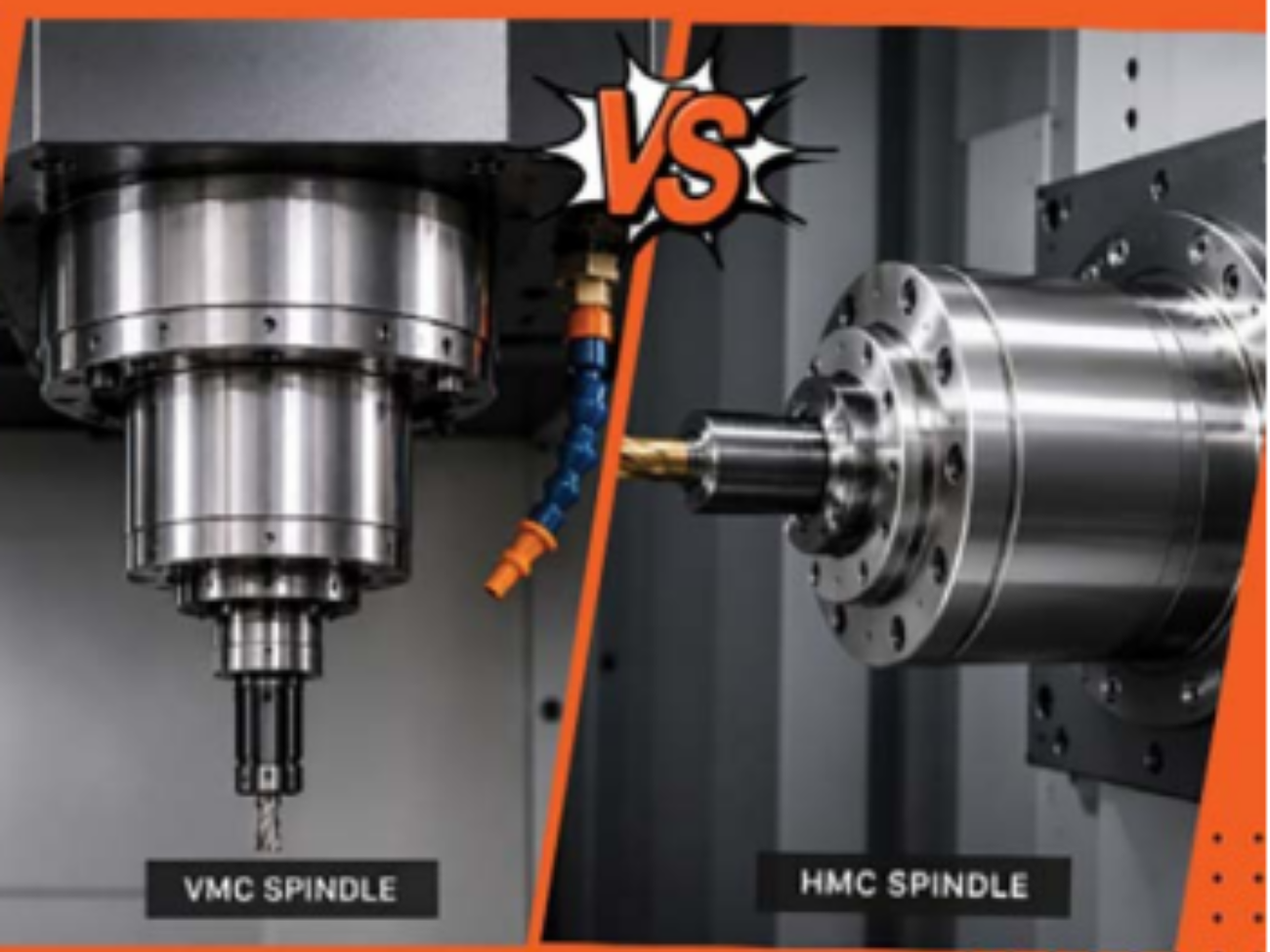
A Vertical Machining Center (VMC) positions the spindle vertically, so cutting tools approach the workpiece from above. Parts sit flat on a horizontal worktable, held by vises or fixtures, with gravity naturally assisting work holding stability.
What separates a machining center from a basic milling machine? The Automatic Tool Changer (ATC). VMCs carry tool magazines with 12 to 200+ tools, swapping cutters automatically between operations drilling, tapping, boring, face milling, contouring, and pocketing all within a single setup.
VMC is ideal for:
– Flat and single-surface parts.
– Simple prismatic profiles and slots.
– Low-to-medium production volumes and high-mix work.
– Large, heavy mould bases and die plates.
– Prototype and R&D machining.
What is a Horizontal Machining Center?
A Horizontal Machining Center (HMC) orients the spindle horizontally, parallel to the worktable. Workpieces mount on pallets or rotary tables, enabling multi-sided machining in a single setup, typically four to five faces without repositioning.
HMCs are built around a fundamentally different philosophy: minimise setups, maximise spindle on-time. Two-pallet changer integration means one part is being machined while the next is being loaded, eliminating operator wait time entirely.
HMC is ideal for:
– Cube-shaped and multi-face prismatic parts.
– High-volume repetitive production.
– Automotive, commercial aerospace, and hydraulic component manufacturing.
– Complex geometries requiring multi-axis access.
– Lights-out and automated manufacturing environments
5 Critical Differences That Affect Your Production
- Spindle Orientation and Part Access Vertical spindles are intuitive operators. They see exactly what the tool is doing. But they limit access to a single work plane. Machining five sides of a cube on a VMC means flipping and re-fixturing the part five times, introducing handling time, potential positioning error, and lost spindle utilisation.
Horizontal spindles let the workpiece rotate on a pallet or rotary table, bringing multiple faces into the cut without unmounting the part. This single factor is the biggest productivity advantage of HMCs for complex prismatic parts.
- Chip Management Gravity works against VMCs. Chips fall onto the workpiece and accumulate in cavities, affecting surface finish, accelerating tool wear, and requiring frequent clearing stops. Additional chip management systems become a necessary cost.
HMCs benefit from gravityassisted chip evacuation. Chips fall away from the cutting zone naturally, improving surface finish, extending tool life, and eliminating chip recutting, one of the most damaging events in precision machining.
- Setup Time vs. Multi-Face Capability VMCs win on initial setup speed. Open access, straightforward fixturing, and familiar operation mean faster first-part-on-table time. For one-off or short-run work, this matters.
HMCs require longer setup, but that investment pays back on every cycle. A job that needs four setups on a VMC runs in one setup on an HMC. For any meaningful production volume, the math shifts decisively towards horizontal.
- Machine Rigidity and Accuracy HMCs are built around Meehanite cast iron bases with V-shaped rib reinforcement and box-way designs. This architecture absorbs vibration and maintains accuracy under heavy cutting loads, essential for consistent tolerances in production environments.
VMCs deliver excellent accuracy for single-face work but can be less rigid under aggressive cuts on tall or overhanging workpieces.
- Automation and Lights-Out Manufacturing Both platforms support automation, but HMCs are built for it. Twin-pallet changers are often standard. Pallet pool systems, where 10, 20, or more pallets cycle through a single machine, are the backbone of lightsout manufacturing in automotive and commercial aerospace. VMCs can be automated with robotic loading and quick-change work holding, but the integration is typically more complex and less seamless than native HMC pallet systems.
This article was taken in TAGMA TIMES Magazine