

-Sanjay Chavre, Advisor, TAGMA India
Global institutions specializing in mold making technologies range from research-intensive universities to industry-led vocational centers. India has a particularly robust ecosystem of “Tool Rooms” that bridge the gap between academic theory and shop-floor skills.
Global Institutions: Research & Vocational Training
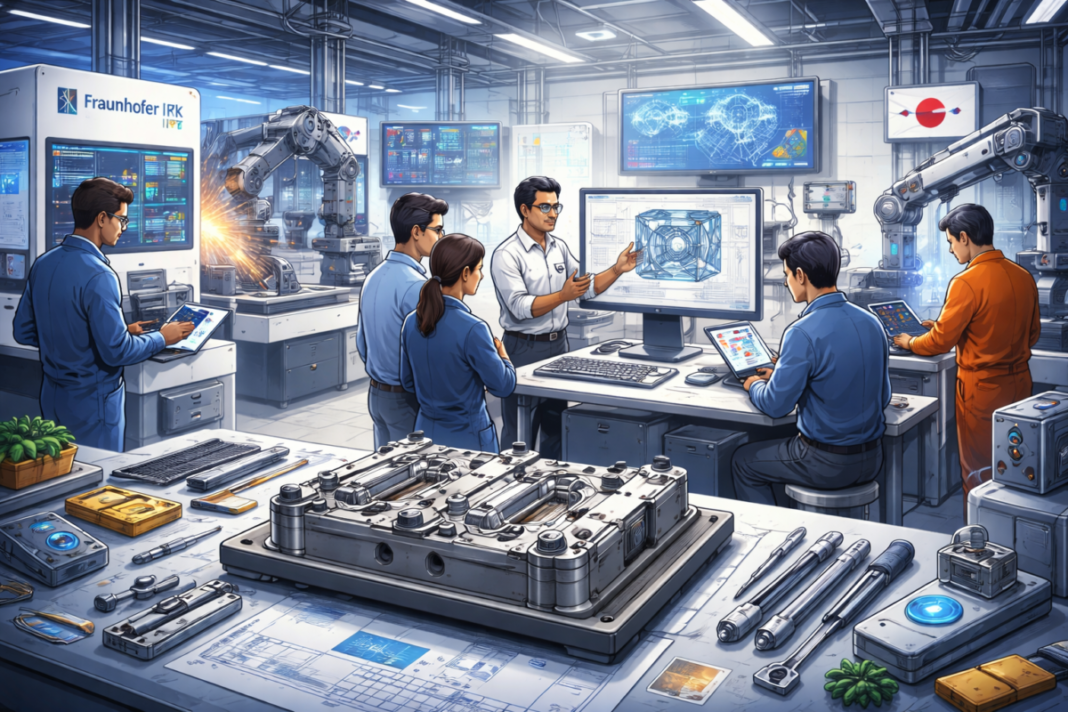
- Fraunhofer IPK (Germany)
● Focus: Advanced tool and mold making research, micro-injection molding, and additive manufacturing.
● Strengths: They are world leaders in “Integrated Tooling,” focusing on digital twins, high-precision machining, and smart molds with integrated sensors.
● Industry Interaction: They collaborate with European automotive and aerospace giants (e.g., Volkswagen, Airbus). Their “Precision Manufacturing” lab serves as a pilot plant for SMEs to test new molding technologies before commercialization. - American Injection Molding (AIM) Institute (USA)
● Focus: Practical engineering for the plastic injection molding industry.
● Strengths: Known for their PTE (Plastics Technology & Engineering) certificate, which is the only ANSI-accredited program of its kind. They focus on the science behind the process (Scientific Molding).
● Industry Interaction: AIM acts as a training hub for major North American manufacturers. Their “Molder’s Series” is a gold standard for upskilling existing technicians. - Penn State Behrend – Plastics Training Academy (USA)
● Focus: Undergraduate plastics engineering and professional workforce training.
● Strengths: Home to the largest academic plastics processing lab in the U.S. They excel in Design of Experiments (DOE) for injection molding and mold design basics.
● Industry Interaction: They host the annual “Innovation and Emerging Plastics Technologies Conference,” drawing hundreds of industry partners. - ETH Zurich – Advanced Manufacturing Lab (Switzerland)
● Focus: High-end research in machine tools and reconfigurable molding strategies.
● Strengths: Researching “Waste-free” molding (e.g., robotic sand molding) and high-tolerance metal molding processes.
● Industry Interaction: They are part of the Swiss Manufacturing Survey network, directly influencing Swiss precision engineering standards (e.g., for watchmaking and medical devices). - Kongju National University (South Korea)
● Focus: Metal mold technology research and digital convergence.
● Strengths: Specialized “Global Metal Mold Technology Research Center” that focuses on 3D printing for mold inserts and digital manufacturing.
● Industry Interaction: Heavily integrated with the Korean electronics and automotive supply chain (Samsung, Hyundai).
Indian Institutions: Skill Development & Tool Engineering
India’s strength lies in a network of government-supported Technology Centres (Tool Rooms) established in collaboration with countries like Germany and Denmark.
| Institution | Key Strengths | Industry Interaction Portfolio |
| CIPET (Central Institute of Petrochemicals) | Plastics processing, specialized mold design, and material testing. | Partners with local plastic clusters and MNCs like Reliance and Tata Motors for workforce supply. |
| CTTC (Central Tool Room, Bhubaneswar) | Aerospace-grade precision tooling and 5-axis machining. | Manufactures precision components for ISRO (Chandrayaan missions) and HAL. |
| IGTR (Indo-German Tool Room, Aurangabad/Indore) | High-end Tool & Die making, CAD/CAM/CAE integration. | Strong ties with the automotive belt in Maharashtra; provides consultancy to SMEs for tool optimization. |
| CITD (Central Institute of Tool Design, Hyderabad) | Automation in molding and design of complex press tools. | Acts as a design hub for defense and public sector units in South India. |
| NTTF (Nettur Technical Training Foundation) | Vocational excellence, Industry 4.0, and “Mechatronics” in molding. | Strong partnership with BOSCH and Toyota; unique 3-year diploma focusing on “Employer-led” training. |
| ISTC (Indo-Swiss Training Centre, Chandigarh) | Swiss-style apprenticeship in Die and Mold making. | Focuses on precision instrument molding; graduates are highly sought after by European firms operating in India. |
Discussion of Strengths & Interactions
Strengths in Technology
● Precision vs. Production: Global institutions like Fraunhofer and ETH focus on “Next-Gen” tech (lasers, micro-molding, and AI-driven process control). In contrast, Indian institutions like CTTC and CIPET excel in “Standard-Setting” tech—ensuring that a technician can design and manufacture a mold that lasts for 1 million cycles with micron-level accuracy.
● Vocational Depth: The NTTF and IGTR models are unique because they treat the “Worker” as an “Engineer.” Their 4-year diplomas include 1 full year of shop-floor internship, which is rare in global university settings.
Portfolio of Industry Interactions
● Collaborative R&D: European and US institutions (Penn State, AIM) use a Consortium Model, where several companies fund research and share the results.
● Production-cum-Training: Indian Tool Rooms (CTTC, IGTR) operate as Job Shops. They take actual orders from industry (e.g., a mold for a car bumper) and involve students in the manufacturing process. This ensures that the training is 100% relevant to market needs.
Conclusion: Bridging Global Innovation with Indian Scalability
Global institutions set the benchmark for cutting-edge mold making research and vocational excellence, while India’s Tool Rooms deliver practical, industry-ready skills at scale. Together, they form a symbiotic ecosystem—pioneering technologies abroad and adapting them for high-volume production in emerging markets. As manufacturing evolves toward Industry 4.0 and sustainability, these institutions will remain pivotal in training the next generation of toolmakers, ensuring precision, efficiency, and innovation worldwide.

About the Author:
Sanjay Chavre, Advisor – TAGMA India
A respected technocrat and policy strategist, Mr. Sanjay Chavre has been a pivotal figure in the evolution of India’s manufacturing and tooling ecosystem. With decades of experience at the intersection of government and industry, he has contributed to the development of forward-looking policies that promote indigenous technology, strengthen domestic capabilities, and uplift MSMEs within the tooling and precision engineering sectors.
Mr. Chavre has held key roles in various government departments and has been instrumental in formulating and executing initiatives that align with India’s long-term vision for industrial growth and self-reliance. His expertise lies in enabling public-private collaboration, fostering innovation ecosystems, and building frameworks that support sustainable industrial development.
In his current role as Advisor to TAGMA India, he continues to guide efforts aimed at enhancing the global competitiveness of Indian toolmakers. His insights have been vital in positioning the Indian tooling industry as a reliable and technologically advanced partner in the global supply chain