
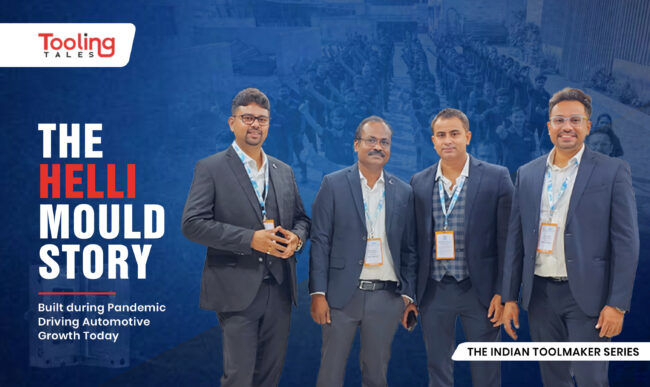
There is a particular kind of ambition that doesn’t announce itself loudly. It accumulates quietly in a decade of shop-floor shifts, in late-night conversations about the future, and in the stubborn decision to reinvest every rupee of profit back into a machine you know you’ll need someday. That is the ambition that built Helli Moulds.
Founded in Vasai by four toolroom veterans, Helli Moulds has gone from a 1,200 square foot rented unit with eight employees to a 15,000 square foot facility running with 11 VMCs, 6 EDMs, a gun drilling machine, a 200-tonne die spotting press, and 660-tonne & 250-tonne moulding machines. In under six years, the company entered the commercial automotive toolroom space and landed work for one of India’s most high-profile vehicle launches. This is how they did it.
The Plan That Took Four Years to Execute
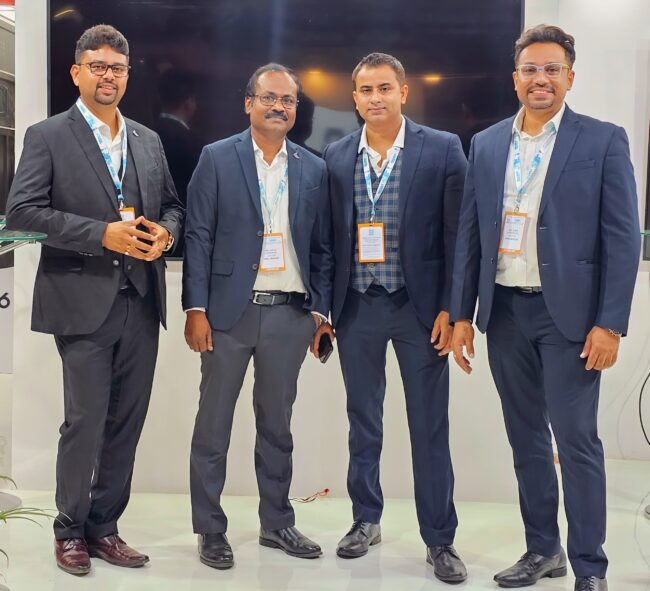
The idea was born in 2016, not in a boardroom, but at a gathering among colleagues. Three men who had spent 14 years together at Sridevi Tools asked themselves a simple question: Is this it?
“If you look at the core competency needed to start a toolroom, we had it all. What we didn’t have was the exposure of running a business.” ~ Subin Vadakkiniyil
That honest self-assessment kept them patient. They spent three years brainstorming and saving for funds, focusing on building discipline before making the leap. In 2019, they formally established the company and secured their first order, marking the beginning of their journey. In early 2020, they signed on a 1,200 sq. ft. shop in Vasai and started with just eight people weeks before COVID-19 brought the world to a halt. Their new 15,000 sq. ft. factory was 70% complete and still under construction when the pandemic was declared.
The Survival Grip
Helli Moulds was born during one of the most difficult periods, the pandemic. The facility was still under construction, and they were working out of a small 1200 square foot location with only one CNC machine. During this uncertain period, Bhosale sir and his team from Samsonite placed their trust in Helli Moulds, becoming the first customer, and that small business gave hope and encouragement when the company needed it the most.
I still remember his visit to our Kaman site. Standing there in the middle of an unfinished factory, He smiled and said, “Good luck.” You’ll do well.” That trust from Samsonite didn’t just start Helli Moulds. It shaped who we are: a company built on relationships, resilience, and results. says ~ Subin Vadakkiniyil
The TACO Connection and the Jeep Meridian
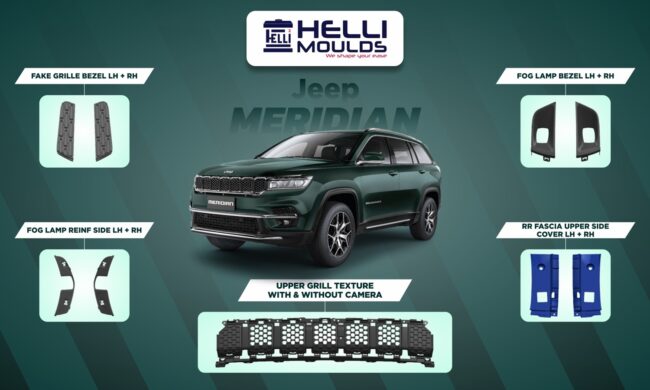
Entry into the automotive toolroom, the big leagues of Indian manufacturing, didn’t come through cold pitches. It came through credibility built over years. TACO (Tata AutoComp Systems) had tooling heads, Mr. Menon and Mr. Stany, who had watched Helli’s founders work during their Sridevi years. That familiarity became trust. That trust became an order for the Jeep Meridian, a flagship project that put Helli squarely on the automotive map. From there, the path to Tata Motors’ supply chain was no longer theoretical. It was underway.
The Machine-First Philosophy
Asking Mr. Abhishek Singh about what has been the strategy behind Helli Moulds for the past six years, the answer is direct.
“We haven’t taken profit out of the company. Whatever money was saved, we invested it in machinery.” ~ Abhishek Singh
This is not a line for effect. It is an operational ideology. Every year, Helli targets a minimum of three new machines. Capital expenditure has scaled from ₹50 lakhs in the early years to ₹3 crore last year. The rationale is grounded in lived experience: India’s toolroom sector suffers from a fragmented supplier ecosystem that cannot match the integrated clusters giving Chinese toolmakers their delivery edge. Helli’s answer is vertical integration, bringing everything in-house.
“In the beginning, we didn’t have gun drilling. We didn’t have die spotting. Trials were delayed because outside machines weren’t available. Now that everything is under one roof, we cater to our customers on time.” says Mr. Wiljo Vargheese
The human capital strategy is equally deliberate. Helli recruits fresh trainees from NTTF, CIPET, and ITI polytechnics, puts them through a mandatory one-year shop floor training programme, maps their skills against every activity, and assigns work accordingly.
The Problem No One Talks About
For all its growth, Helli’s story carries a stark industry warning. Payment delays, chronic, structural, and systemic, nearly broke the company in its first three years. The founders had orders. They had capability. What they didn’t have was cash when salaries, supplier bills, and machine EMIs came due simultaneously.
“It was literally very difficult to survive. Many toolrooms in India collapse within three years, not because they lack skill, but because OEMs don’t pay on time. If OEMs don’t pay us, we can’t pay our suppliers. From Tier 1 to Tier 4, the same issues persist. It’s a complete chain. If it breaks at the top, everything below is ruined.” ~ Ankit Patil
A bank overdraft facility eventually provided relief. But the underlying problem remains unresolved, and it is a structural issue. India’s manufacturing ambitions cannot afford to be ignored, especially as OEMs look to position the country as a credible alternative to China.
What Comes Next for Helli
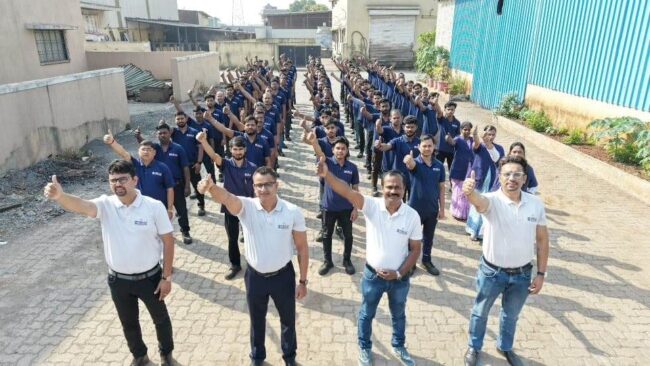
Helli’s five-year plan is an extension of the same philosophy that got it here: keep investing, keep building capability, and reduce dependence on outside suppliers to zero. The goal is not just growth. It is to become the kind of Indian toolroom that OEMs no longer need to look to China to replace. In the founders’ view, India has the talent. What it needs is the infrastructure, the patience, and the systemic support, particularly on payments, to let companies like Helli scale into that gap.
“Even now, many OEMs are still depending on China tool makers. We want to change that.” ~ Abhishek Singh