

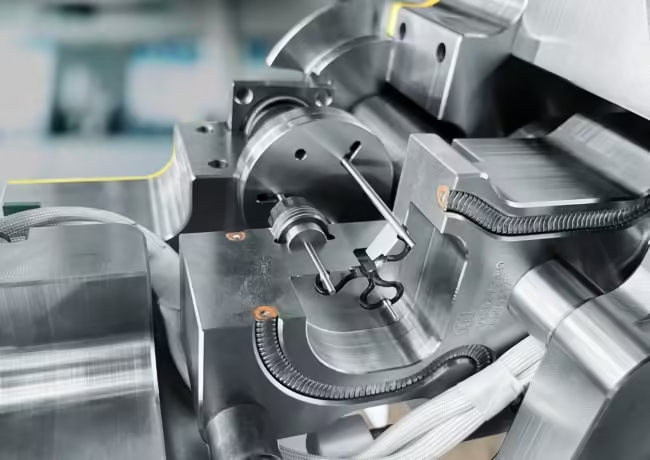
Meusburger has expanded its hot runner portfolio with smartFLOW Helix, a solution developed specifically for valve gate applications in injection moulding. The company stated that the technology is designed to optimise flow control in the nozzle area and support the reliable processing of challenging plastics.
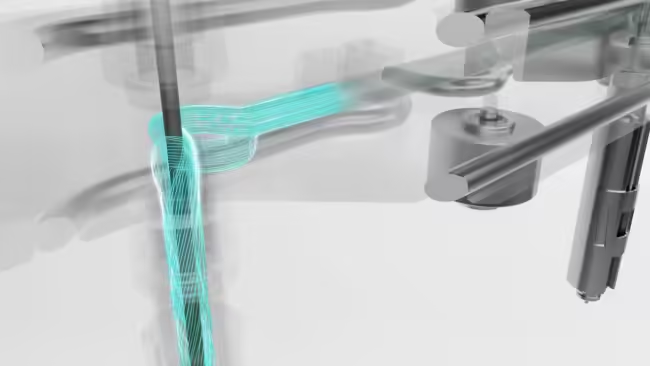
According to Meusburger, smartFLOW Helix is based on the existing smartFLOW manifold technology and has been specially developed for use in valve gate hot runner systems. The solution features a special flow geometry that generates a defined vortex, or helical flow, within the nozzle.
The company explained that this geometry homogenises the melt flow immediately before it enters the cavity, reducing differences in temperature and pressure within the melt and promoting more uniform filling. Meusburger added that the optimised flow control is particularly beneficial for complex geometries and thin-walled components, helping to ensure stable mould filling.
Optimisation of valve gate applications
Valve gate systems place high demands on flow control in the gate area. Conventional systems can, for example, lead to so-called ‘pin shadows’ in the injection area. The unique geometry of smartFLOW Helix eliminates these effects. The targeted mixing of the melt in the nozzle area promotes uniform material distribution, which minimises injection defects and improves the visual quality of the items.
Rheologically designed flow channels and diffusion-welded manifolds
In addition to its specialised flow technology, Meusburger uses diffusion-welded hot runner manifolds, which ensure uniform melt flow thanks to their rheological design. This is optimally aligned with the flow properties of the plastics. Diffusion welding enables the creation of complex channel layouts with high dimensional accuracy and surface quality. This helps to reduce pressure losses and localised hotspots.
Added value for sophisticated applications
Meusburger recommends smartFLOW Helix particularly for frequent colour changes, applications with high visual quality requirements, multi-cavity moulds and technical plastics. Improved homogenisation of the melt helps to ensure consistent part quality and stable processes. The technology also offers advantages in standard applications: Consistent filling reduces the risk of unusable parts and improves process reliability in serial operation.