

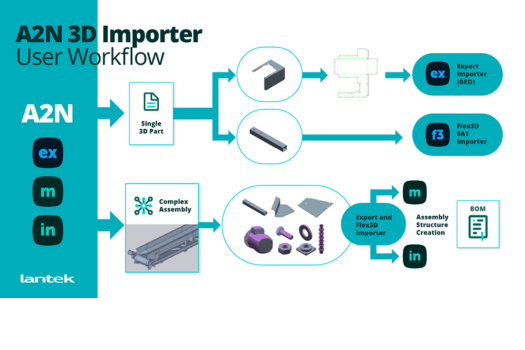
Lantek has recently announced a significant enhancement to its Assembly to Nesting (A2N) function with the automatic importation of standard bevels from 3D models. This new feature introduced in Lantek version 44, is designed to streamline workflows for users working with bevel-edged sheet metal parts typically used in welding preparation. Lantek experts will be available to discuss this new technology at Booth A3106 during FABTECH 2025, taking place from October 8-11 at McCormick Place, Chicago, Illinois.
Until now, bevels had to be manually defined after importing 3D files into Lantek Expert. With this new functionality, A2N can now detect standard bevel types directly from the 3D geometry and automatically assign the appropriate technology during the import process. This eliminates the need for manual editing in the Drawing Module and significantly reduces preparation time while ensuring greater consistency and precision.
The bevel detection feature is seamlessly integrated with both Lantek Expert and Lantek MES/Integra, allowing users to import complete 3D parts or assemblies while maintaining all necessary manufacturing information. Support for imperial units and new additions such as bend deduction and K-Factor tables in the interface further expand A2N’s versatility. Additionally, improvements have been made to kit management for better organization of complex assemblies.
Lantek A2N plays a key role in bridging CAD and CAM workflows. Designed to manage parts and assemblies in various formats—including sheet metal, tubes, and beams—A2N allows for quick disassembly and part recognition, enabling accurate quotation and smooth integration during the production process. It is particularly valuable for job shops and manufacturing teams dealing with a high volume of design variations or complex 3D structures.
Alongside this new functionality, Lantek will also showcase other recent developments in its software suite, all aimed at simplifying and accelerating the transition from design to production in the sheet metal industry.