

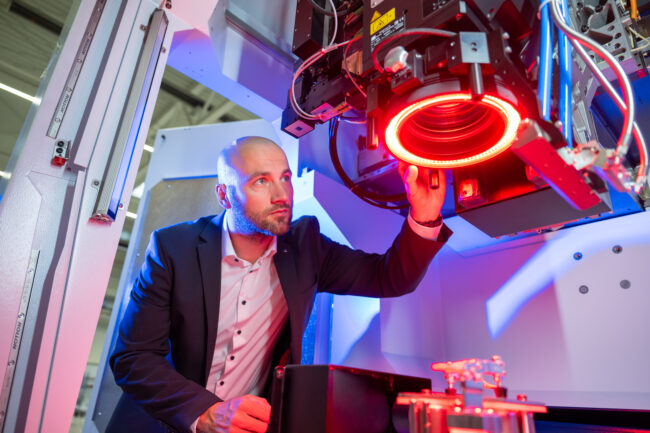
TRUMPF has introduced a new system solution designed to enhance the quality and efficiency of welding processes. The solution integrates multiple sensors that monitor each step of the laser welding process. An AI-powered quality control system inspects the weld seams, while OCT (optical coherence tomography) measures the laser’s welding depth.
“Our solution is unique on the market. TRUMPF offers all components, such as the beam source, sensors, and optics, from a single source. We also take care of installation, service, and programming of the system, which is tailored to the user. Our customers don’t need any additional interfaces and don’t have to coordinate with different suppliers,” says Martin Stambke, Product Manager at TRUMPF. The high-tech company is showcasing the system solution at the world’s leading trade fair, LASER – World of Photonics, in Munich.
Cost-efficient and high-performance
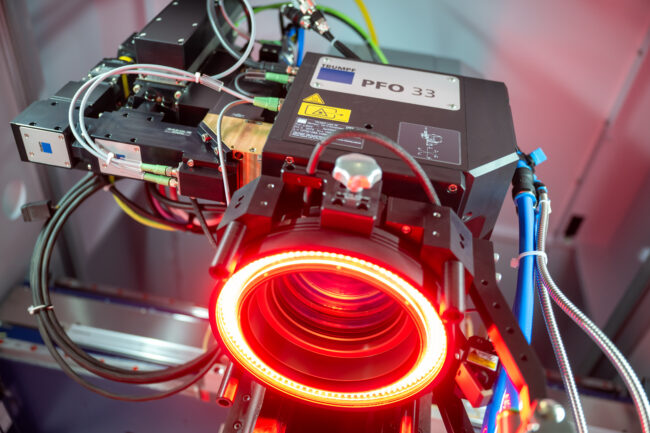
The solution allows users to weld precision components that require defect-free results, such as electric car batteries or hairpins for electric motors. Achieving flawless weld seams depends on setting the optimal working distance between the components and the laser. This is achieved through the programmable PFO 33 focusing optics, which independently adjusts the laser’s focus position. “This so-called 2.5D mode is more cost-effective in many applications than 3D mode, in which the PFO can still move up and down during the welding process. This is because less complex controls and programming, as well as fewer moving axes, reduce acquisition, operating, and maintenance costs for the user. In addition, it is faster for the optics to adjust the focus position themselves than to move the entire optics up and down in the laser cell. Our solution is therefore cost-efficient, yet powerful,” says Stambke.
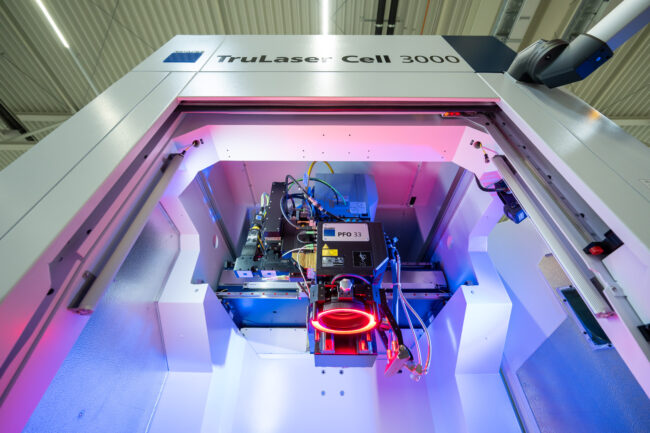
The system solution combines laser, optics, and sensor technology for the production of complex components (Image: TRUMPF)
Better weld seam quality from the very first component
With integrated optical coherence tomography (OCT), users can not only monitor the welding depth of the laser, but also check the distance between the laser and the component. “This ensures the focus position of the laser and prevents welding errors,” says Stambke.
Moreover, VisionLine Inspect is used to check the quality of the manufactured components. A camera takes a picture of the weld seam and the system uses artificial intelligence (AI) to detect any potential errors. By combining AI preprocessing and conventional algorithms, TRUMPF creates traceability and transparency.